How to Build an Audit-Ready Reconciliation Framework Across Finance Processes (2026 Guide)
If your auditor’s first two weeks of fieldwork are spent chasing unreconciled balances, the problem usually isn’t the audit. It’s the reconciliation process behind it.
An audit-ready reconciliation framework is a standardised way of matching every key account- bank, receivables, payables, intercompany, fixed assets, payroll and tax- to a supporting source before the auditor asks for it, with a named owner, a fixed cadence, and evidence attached.
Under the Companies Act, 2013 and the Standards on Auditing issued by ICAI, this isn’t optional documentation. It’s the foundation auditors test before they form an opinion.
This guide breaks down what the framework looks like in practice, how to reconcile each account category, what CFOs should measure, and how Indian audit-trail and CARO 2020 requirements now shape reconciliation design.
Key Takeaways
- An audit-ready reconciliation framework rests on four elements: risk-based tiering, a fixed monthly cadence, named ownership, and attached evidence.
- Unreconciled schedules handed over at fieldwork start are the single biggest driver of audit delay.
- The Companies (Accounts) Rules, 2014 audit-trail proviso and the auditor’s reporting under Rule 11(g) mean reconciliation evidence is now something auditors actively test.
- Bank, receivables, payables, payroll, and statutory dues need monthly reconciliation. Intercompany and fixed assets are the accounts most commonly left behind.
What Is an Audit-Ready Reconciliation Framework?
An audit-ready reconciliation framework is a documented, repeatable system for confirming that every balance in the general ledger agrees with an independent source before the books close. It goes beyond a monthly reconciliation checklist. It defines which accounts get reconciled, how often, by whom, what evidence gets attached, and what happens when a variance can’t be explained.
Three things separate this from an informal reconciliation habit.
1. It’s risk-based, not uniform.
High-volume or high-risk accounts (bank, intercompany, payroll) get reconciled more often than low-movement accounts (say, a dormant deposit).
2. It produces evidence, not just a matched number.
A reconciliation that shows a balance agrees but has no supporting statement, ageing report, or sign-off attached still fails an audit test.
3. It assigns ownership before the discrepancy appears.
Waiting until fieldwork to figure out who owns the intercompany mismatch is where most delays start.
Why Does Reconciliation Break Down Before Audit Fieldwork Starts?
Most reconciliation programs fail because the reconciliation isn’t structured to survive scrutiny.
The table below sets out the patterns SGGK sees most often across statutory audits, and why each one creates friction once fieldwork begins.
Common Gap | Why It Happens | Effect on the Audit |
Reconciliations done, but not reviewed | Preparer signs off, no second reviewer | Auditor treats the reconciliation as unverified, re-performs the work |
Variances left “pending investigation” for months | No SLA for closing variances | Aged, unexplained differences become audit qualifications |
Intercompany balances don’t match between entities | No common cut-off date or shared confirmation process | Consolidation adjustments and elimination entries get questioned and FEMA Non-Compliances |
Bank reconciliation done, GST/TDS reconciliation skipped | Tax reconciliation seen as a compliance filing task, not a close task | Mismatches surface as departmental notices, not audit findings |
Reconciliation exists in someone’s personal spreadsheet | No central repository or version control | Auditor can’t verify who prepared it or when |
This overlaps closely with what SGGK’s audit documentation research found across statutory audits that ran past schedule: the accounts weren’t wrong; they just weren’t provable in time.
What Does an Audit-Ready Reconciliation Framework Look Like?
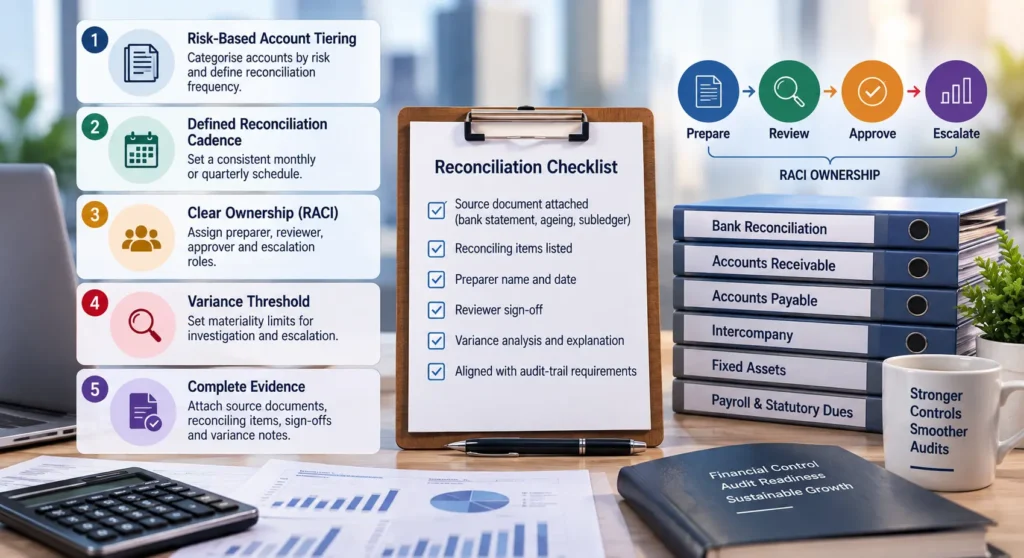
A working framework rests on five decisions made in advance, not during fieldwork.
1. How Should Accounts Be Tiered by Risk?
Not every account needs the same reconciliation intensity. A three-tier model works for most mid-sized and growing companies.
- Tier 1 (monthly, always reviewed): Bank, receivables, payables, payroll, GST and TDS liability accounts.
- Tier 2 (monthly or quarterly, sample-reviewed): Intercompany balances, fixed assets, prepaid expenses, provisions.
- Tier 3 (quarterly or at year-end): Low-movement accounts, dormant balances, deposits with negligible activity.
2. What Reconciliation Cadence Prevents Audit Delay?
Reconciling once a year, at year-end, is the single biggest reason audits stretch. A monthly cadence for Tier 1 and Tier 2 accounts means variances get caught and explained while the transaction is still fresh, not five months later during fieldwork. SGGK’s research on audit timelines found that reconciliation cadence, more than headcount, was the variable that separated audits closing on schedule from ones that didn’t.
3. Who Should Own Each Reconciliation?
Ownership has to be assigned by name. A RACI matrix does this by giving every task four possible roles: Responsible (does the work), Accountable (owns the outcome and signs off, with one person per task), Consulted (provides input before sign-off), and Informed (kept updated on the result). Applied to reconciliation, it means no account is left without a preparer, a reviewer who answers for it, and a defined escalation route. The implication for your team is that an unexplained variance never has an ambiguous owner.
Role | Prepares Reconciliation | Reviews for Accuracy | Approves & Signs Off | Escalates Unresolved Variances |
Process owner (AP, AR, Payroll lead) | ✔ | ✔ (if aged beyond SLA) | ||
Reconciliation preparer / Accountant | ✔ | |||
Finance Controller | ✔ | ✔ | ✔ | |
CFO | ✔ (material items) | ✔ (to audit committee/board) | ||
Internal Audit | ✔ (sample basis) | ✔ |
4. What Variance Threshold Should Trigger Escalation?
A framework needs a numeric or percentage threshold, agreed in advance, above which a variance must be investigated and documented rather than adjusted and closed.
Many mid-sized companies use a combination: an absolute rupee threshold (say, above a fixed amount per account) and a percentage-of-balance threshold, whichever is lower. The point isn’t the exact number. It’s having one that’s written down and consistently applied, so the auditor sees a rule being followed.
5. What Evidence Should Every Reconciliation Carry?
At minimum, each reconciliation should have the source document (bank statement, ageing report, subledger extract), the reconciling items listed individually, the preparer’s name and date, the reviewer’s sign-off, and a note on any variance above the threshold. Each account balance is adequately supported and ensure such balances are not misstated. Example: Accrued expense.
This is the same evidence base auditors expect when testing the audit-trail requirement under the Companies (Accounts) Rules, 2014, discussed further below.
How Do You Reconcile Each Key Account Category?
Each account type carries a different risk profile and a different reconciliation source. Here’s how the audit-ready reconciliation framework applies across the accounts CFOs are asked about during audit fieldwork.
Account / Process | Reconciled Against | Frequency | Key Risk If Skipped | Evidence Auditors Expect |
Bank | Bank statement | Monthly | Unrecorded transactions, timing differences, fraud indicators | Bank statement, reconciliation statement, outstanding cheque/deposit list |
Receivables (AR) | Customer ledger, ageing report | Monthly | Overstated revenue, doubtful debts not provided FEMA Non-compliance | Ageing schedule, customer confirmations, provisioning workings |
Payables (AP) | Vendor ledger, GRN/PO | Monthly | Understated liabilities, duplicate payments FEMA Non-compliance | Vendor statements, ageing schedule, GRN-to-invoice match |
Intercompany | Counterparty entity’s books | Monthly, common cut-off | Elimination mismatches at consolidation | Confirmation from counterparty entity, shared cut-off memo |
Fixed Assets | Fixed asset register, physical verification | Quarterly (register), Annually (physical) | Ghost assets, depreciation errors, CARO reporting gaps | FAR reconciliation, physical verification report, disposal approvals |
Payroll | HR/payroll system, statutory filings | Monthly | PF/ESI/TDS mismatches, compliance penalties | Payroll register, statutory challan reconciliation, variance explanation |
Taxes (GST, TDS) | GSTR-2B, Form 26AS, books | Monthly | Input credit mismatches, demand notices | GSTR-2B reconciliation, 26AS matching, ITC ledger |
Other key accounts (prepaid, provisions, loans) | Underlying contract/schedule | Quarterly | Misstated balances, missed amortisation | Amortisation schedule, loan confirmation, provision workings |
This structure mirrors, in outline, the reconciliation altitudes recognised in Indian practice, where statutory, regulatory and operational reconciliation layers all need to reconcile at once, a distinction explored in more depth in Terra Insight’s reconciliation fundamentals research.
What Does the Audit-Trail Rule Mean for Your Reconciliation Evidence?
This is the part of an audit-ready reconciliation framework that’s changed the most in recent years, and it’s often missed.
Under the proviso to Rule 3(1) of the Companies (Accounts) Rules, 2014, every company using accounting software to maintain its books must use software with an audit trail (edit log) feature that records every transaction and every change made to it, and that feature cannot be switched off.
This has applied to financial years commencing on or after 1 April 2023. Statutory auditors are separately required to report on this under Rule 11(g) of the Companies (Audit and Auditors) Rules, 2014, guided by ICAI’s implementation guidance on audit trail reporting.
What this means for reconciliation practically:
- A reconciliation adjustment made after the books were meant to close needs to show up in the edit log, with a reason.
- Reconciliations maintained purely in offline spreadsheets, disconnected from the accounting software, don’t get captured by this audit trail. That’s a gap auditors are now trained to probe.
- Reconciliation is often where a fraud indicator first surfaces. Unexplained or aged variances are a red flag the auditor weighs under SA 240, and any fraud identified feeds into reporting under CARO 2020 clause (xi). In practical terms, an unresolved variance is a reporting risk, not only a housekeeping item. A related breakdown is available in SGGK’s CARO 2020 explainer and the CARO 2020 internal audit checklist.
Under Standard on Auditing (SA) 230, audit documentation must let an experienced auditor with no prior connection to the engagement understand the nature, timing, and extent of procedures performed. A reconciliation with no reviewer name, no date, and no linked source document doesn’t meet that bar, regardless of whether the number itself is correct.
What Metrics Should CFOs Track for Reconciliation Health?
Reconciliation is one of the few finance functions where quality can be measured directly. The table below sets out 2026 benchmarks worth tracking against.
Metric | 2026 Benchmark | Source |
Finance teams closing books in 3 days or less | 18% | |
Finance teams needing 6+ business days to close | 50% | |
Close-cycle reduction with automated bank reconciliation | 8.2 to 3.5 days | |
Organisations still reconciling intercompany manually | 54% | Deloitte survey, via BlueCopa, 2026 |
Finance leaders using AI somewhere in their function | 59% | |
Teams that caught a material discrepancy manual review missed | 68% (within the prior year) | BlackLine 2025 Modern Accounting Survey, cited in SolveXia’s 2026 data |
Beyond these industry figures, CFOs should track internally: percentage of Tier 1 accounts reconciled by the scheduled close date, average age of open variances, and number of prior-year audit observations repeated. A rising repeat-observation count is usually the clearest signal that the reconciliation framework, not the underlying accounting, needs attention. SGGK’s broader view on this is covered in why CFOs should review internal audit reports every quarter.
How Do You Roll This Out Without Disrupting the Current Close?
A phased rollout avoids the common failure mode of trying to fix every account category at once.
- Week 1-2: Map & Tier. Create a list of all the GL accounts, assign it to a tier, and determine the present ownership (gap) of the reconciliation process for each account.
- Week 3-4: Begin by fixing Tier 1. Align the templates, frequency and approval process of bank, receivable, payable, payroll and statutory liabilities GL accounts.
- Weeks 5-8: Continue with Tier 2. Include inter-company and fixed asset GL accounts in one single cadence with a uniform cut-off date.
- Weeks 9 to 12: Build the escalation and evidence layer. Set variance thresholds, assign the review layer, and start mapping reconciliations directly to the PBC list ahead of the next audit cycle.
Companies preparing for their first statutory audit after a funding round often need to compress this timeline. A structured pre-fieldwork approach for that scenario is covered in SGGK’s audit preparation checklist for funded startups.
Where Does Audit-Ready Reconciliation Framework Discipline Pay Off?
An audit-ready reconciliation framework isn’t built in the two weeks before fieldwork starts. It’s built through a risk-based tiering approach, a monthly cadence for the accounts that matter most, named ownership with a clear review layer, and evidence that satisfies the audit-trail expectations now built into Indian company law. Get those four elements right, and the audit becomes a review of work already done, rather than a scramble to produce it.
If your team is mapping out this framework ahead of the next audit cycle, a structured conversation with an audit support team can help identify which accounts carry the most risk for your specific business. SGGK’s audit support services work alongside finance teams to build exactly this kind of reconciliation and documentation discipline before fieldwork begins.
Strengthen Your Reconciliation Framework
Frequently Asked Questions About Audit-Ready Reconciliation Framework
How often should balance sheet accounts be reconciled before an audit?
Tier 1 accounts, bank, receivables, payables, payroll and statutory dues, should be reconciled monthly. Lower-movement accounts can be reconciled quarterly, provided the framework documents why that frequency was chosen.
What's the difference between an account reconciliation and an audit reconciliation process?
Account reconciliation confirms a balance agrees with a source. An audit reconciliation process adds the evidence trail, ownership, and review layer needed for that reconciliation to withstand independent testing during a statutory audit.
Does every company need to reconcile intercompany balances monthly?
Companies with multiple group entities or overseas subsidiaries should, since mismatched intercompany balances are one of the more common consolidation and elimination issues auditors flag, particularly where cut-off dates aren't aligned across entities.
What happens if reconciliation evidence isn't available during audit fieldwork?
The auditor has to perform additional substantive procedures to gain comfort over the balance, which extends fieldwork timelines and can lead to management letter observations or, in more significant cases, a qualified opinion.