CARO 2020 Explained: What Every Indian Company Must Report in FY 25-26
If your company is due for a statutory audit this year, your auditor will almost certainly attach a CARO report to the audit opinion. Most finance teams treat this as a routine annexure. In reality, the CARO report is often one of the first documents lenders, regulators, investors, and audit committees review when assessing a company’s compliance and governance practices.
The Companies (Auditor’s Report) Order, 2020, or CARO 2020, is issued by the Ministry of Corporate Affairs under Section 143(11) of the Companies Act, 2013. It asks statutory auditors to report on 21 specific matters. These span fixed asset records, statutory dues, fraud disclosures, and going concern.
For FY 25-26, the structure of CARO 2020 has not changed since it replaced CARO 2016. But auditors are generally expected to back every conclusion with clear working papers, particularly as NFRA inspections have increased scrutiny of audit documentation quality in recent years.
This guide is for CFOs, Company Secretaries, auditors, and finance managers. It covers CARO 2020 applicability, what each of the 21 clauses asks for, and the groundwork that speeds up the audit.
What is CARO 2020, In Plain Terms?
CARO 2020 is not a separate audit. This is the annexure to the statutory auditor’s report which is one of the components of statutory audit reporting in India as per the provisions of the Companies Act, 2013. Here, the auditor presents their findings in 21 reporting areas, which include property records, inventory, statutory liabilities, loan usage, frauds, related party transactions, internal audit systems, CSR compliance, and the ability of the company to meet its financial liabilities as per the MCA.
As compared to CARO 2016, the latest CARO 2020 has increased the number of reporting clauses from 16 to 21, adding more importance to aspects like benami property cases, usage of borrowed money, whistle-blower cases, going concern, and CSR funding. This applies to financial years beginning on or after 1 April 2021.
CARO 2020 is often viewed as an auditor’s reporting requirement. We see it as a governance framework. Every clause reflects a financial control or compliance process that should already operate throughout the year. Companies that build these controls into their regular finance processes generally experience faster audits.
Who Does CARO 2020 Apply To In FY 25-26?
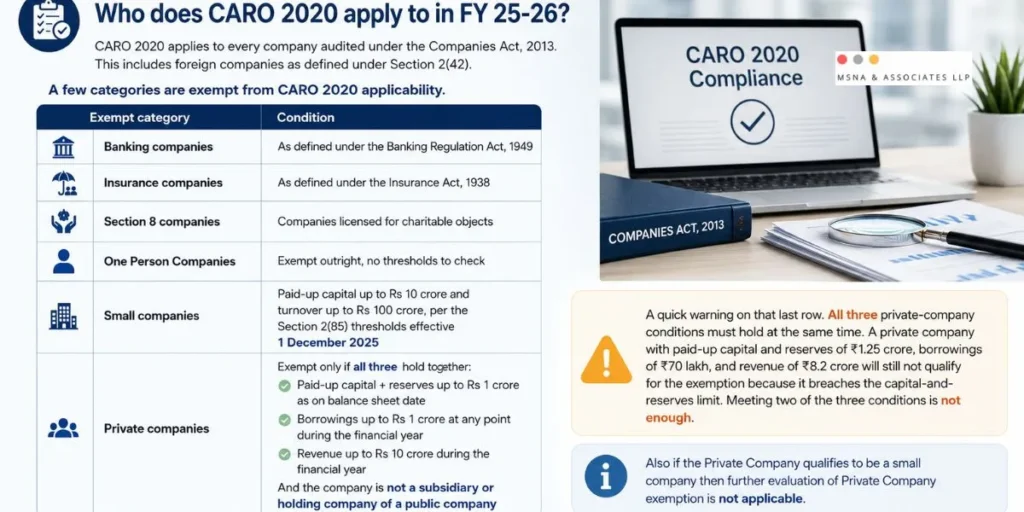
CARO 2020 applies to every company audited under the Companies Act, 2013. This includes foreign companies as defined under Section 2(42).
A few categories are exempt from CARO 2020 applicability.
| Exempt Category | Condition |
|---|---|
| Banking Companies | As defined under the Banking Regulation Act, 1949. |
| Insurance Companies | As defined under the Insurance Act, 1938. |
| Section 8 Companies | Companies licensed for charitable objects under the Companies Act, 2013. |
| One Person Companies (OPCs) | Fully exempt from CARO 2020. No financial thresholds apply. |
| Small Companies | Paid-up capital up to ₹10 crore and turnover up to ₹100 crore, as per Section 2(85) of the Companies Act, 2013 (effective 1 December 2025). |
| Private Companies | Exempt only if all the following conditions are satisfied simultaneously:• Paid-up capital and reserves ≤ ₹1 crore as on the balance sheet date.• Borrowings ≤ ₹1 crore at any point during the financial year.• Revenue ≤ ₹10 crore during the financial year.• The company is not a subsidiary or holding company of a public company. |
A quick warning on that last row. All three private-company conditions must hold at the same time. A private company with paid-up capital and reserves of ₹1.25 crore, borrowings of ₹70 lakh, and revenue of ₹8.2 crore will still not qualify for the exemption because it breaches the capital-and-reserves limit. Meeting two of the three conditions is not enough.
Also, if the Private Company qualifies to be small, then further evaluation of the Private Company exemption is not applicable.
Can a Subsidiary Be A Small Company?
This is a nuanced issue often misunderstood.
- The Act explicitly excludes public companies and their subsidiaries from being treated as Small Companies.
- However, a subsidiary of a private company may still qualify as a Small Company, provided it independently meets the thresholds (capital ≤ ₹10 crores and turnover ≤ ₹100 crores).
Auditors are expected to check applicability afresh every year. Last year’s answer does not carry forward automatically. This reassessment becomes especially important after events like funding rounds, mergers, new borrowings, or changes to the corporate structure, since any of these can affect exemption status.
A mistake we still see a lot
We still see companies relying on the ₹4 crore paid-up capital and ₹40 crore turnover thresholds that applied from September 2022. The MCA revised these again, effective 1 December 2025, and the current thresholds are ₹10 crore paid-up capital and ₹100 crore turnover.
For FY 25-26, use these current thresholds. If your finance team, or a vendor helping you, is still working off the pre-December-2025 numbers, you could end up over-reporting or misjudging your exemption status. Before every statutory audit, it is worth confirming CARO applicability using the current MCA thresholds rather than relying on previous-year assessments.
What the December 2025 revision changes in practice: A private company that crossed the old ₹4 crore / ₹40 crore small-company thresholds sometime in the last two years, and was therefore reporting under CARO 2020 in full, may now fall back under the small-company exemption at the higher ₹10 crore / ₹100 crore limits. This isn’t automatic: the revised limits apply from 1 December 2025, so the assessment depends on which financial year is under audit and what the company’s paid-up capital and prior-year turnover were at the relevant date. Re-run the exemption test for FY 25-26 rather than carrying forward last year’s conclusion, even if that conclusion was correct at the time.
CARO 2020 Clause-wise Analysis: What Auditors Report
CARO does not apply to consolidated financial statements, with one exception. Clause (xxi) requires reporting on qualifications found in the CARO reports of group companies.
Here is what each clause asks the auditor to report on.
| Clause | What the Auditor Reports On |
|---|---|
| 3(i) | Property, plant and equipment (PPE), right-of-use assets, and intangible assets: maintenance of records, physical verification, title deeds of immovable properties, revaluation, and benami property proceedings. |
| 3(ii) | Inventory: physical verification, discrepancies, and whether quarterly returns/statements submitted to banks or financial institutions for working capital limits agree with the books. |
| 3(iii) | Investments, loans, advances in the nature of loans, guarantees, and security provided: terms and conditions, repayment, overdue amounts, renewals/evergreening, and loans repayable on demand or without specified terms. |
| 3(iv) | Compliance with Sections 185 and 186 of the Companies Act, 2013 for loans, investments, guarantees, and security. |
| 3(v) | Compliance with provisions relating to acceptance of deposits or amounts deemed to be deposits, and RBI directions, where applicable. |
| 3(vi) | Whether cost records have been prescribed under Section 148(1) and whether such records have been maintained. |
| 3(vii) | Regularity in payment of statutory dues (GST, PF, ESI, Income Tax, etc.), arrears outstanding, and disputed statutory dues pending before authorities. |
| 3(viii) | Previously unrecorded income surrendered or disclosed during income tax assessments, reassessments, or search proceedings, and whether it has been properly recorded in the books. |
| 3(ix) | Defaults in repayment of loans or borrowings, wilful defaulter status, utilisation of term loans, diversion of short-term funds for long-term purposes, funds raised for subsidiaries/associates, and loans raised against securities of subsidiaries, associates, or joint ventures. |
| 3(x) | Utilisation of money raised through IPO, FPO, debt instruments, preferential allotment, or private placement of shares or convertible debentures. |
| 3(xi) | Fraud by or on the company, reporting under Section 143(12), and whistle-blower complaints received during the year. |
| 3(xii) | Compliance with Nidhi Company requirements relating to net owned funds, deposits, and maintenance of statutory ratios. |
| 3(xiii) | Compliance with Sections 177 and 188 relating to related-party transactions and appropriate disclosures in the financial statements. |
| 3(xiv) | Adequacy of the internal audit system considering the size and nature of the business, and whether internal audit reports were considered by the statutory auditor. |
| 3(xv) | Compliance with Section 192 relating to non-cash transactions with directors or persons connected with directors. |
| 3(xvi) | Registration under Section 45-IA of the RBI Act, conduct of NBFC/HFC activities, Core Investment Company (CIC) status, and CICs within the group. |
| 3(xvii) | Cash losses incurred in the current financial year and the immediately preceding financial year. |
| 3(xviii) | Resignation of statutory auditors during the year and consideration of issues, objections, or concerns raised by the outgoing auditors. |
| 3(xix) | Whether material uncertainty exists regarding the company’s ability to meet liabilities as they fall due within one year, based on financial ratios, ageing, expected realisation/payment schedules, and management plans. |
| 3(xx) | Transfer of unspent Corporate Social Responsibility (CSR) amounts relating to ongoing and other than ongoing projects to the prescribed funds or special accounts within the stipulated time. |
| 3(xxi) | Qualifications or adverse remarks in the CARO reports of companies included in the consolidated financial statements. |
If an answer is unfavourable or qualified, the auditor must also state why.
Which CARO 2020 Clauses Usually Receive the Most Audit Attention?
Not every CARO clause carries the same level of audit effort. In practice, auditors tend to spend more time on clauses that depend on management judgement, continuous documentation, or evidence accumulated throughout the year.
| Clause | Why It Receives Attention |
|---|---|
| 3(vii) | Statutory dues and disputed liabilities. |
| 3(ix) | End use of borrowings and loan defaults. |
| 3(xi) | Fraud by or on the company and whistle-blower complaints. |
| 3(xiii) | Related-party approvals and disclosures. |
| 3(xix) | Going concern assessment. |
| 3(xx) | CSR utilisation and transfer timelines. |
SGGK’s observation: These clauses are not necessarily the most complex. They simply require stronger documentation than many companies maintain during the year, which is why they often generate additional audit queries.
CARO 2020 Checklist: Documents To Keep Ready Before Audit
In our experience supporting audit teams, the clauses that stall fieldwork are rarely the technical ones. They are the ones where the company has not pulled the underlying data together before the auditor asks for it.
Here is a short readiness checklist for meeting CARO reporting requirements, built around the clauses that create the most back-and-forth:
- Clause (i): Keep your fixed-asset list up to date and matched with your books. Have copies of title deeds ready for all property.
- Clause (ii): Keep your inventory physical verification, reconciliation and discrepancies noted. Ensure quarterly returns submitted to banks are reconciled with books.
- Clause (vi): Cost records are maintained.
- Clause (vii): Track when statutory dues are due and when you actually paid them, including anything under dispute. A trial balance alone won’t cut it.
- Clause (ix): Keep a record of what each term loan was approved for, next to how it was actually spent. Auditors now check this loan by loan, not just on your word.
- Clause (xi): Fraud by or on the company are investigated and impacts on financial statements are ascertained. Whistleblower complaints and their status and its impact on the financial statements.
- Clause (xiii): Keep a related-party list that matches your board and shareholder approvals, updated as the year goes by, not stitched together at year-end.
- Clause (xx): Keep your CSR paperwork ready: the profit calculation under Section 198, and the dates any unspent CSR money was transferred.
Getting this ready before the audit starts, instead of scrambling for it clause by clause once the auditor asks, is one of the easiest ways for a finance team to speed up the audit. It’s the same habit that internal audit and audit-support teams already follow all year. That’s why companies that treat these checks as routine usually have the smoothest CARO 2020 reporting.
Common mistakes companies make
- Carrying forward last year’s CARO exemption without testing the current year’s thresholds.
- Not taking clause (ix) seriously. Even if only part of a term loan was used for something other than what was approved, it needs to be reported. It’s not a formality.
- Not backing up the going concern answer in clause (xix). A management letter isn’t enough. You need financial ratios and cash flow numbers to support it.
- Assuming Nidhi or NBFC rules don’t apply. Don’t assume, check clause (xvi) against what your company actually lent or invested that year.
- Leaving related-party approvals for the last minute. Clause (xiii) causes the most delays when this isn’t ready before fieldwork starts.
What non-compliance actually means for FY 25-26?
Missing a CARO clause doesn’t automatically mean a penalty. But it can lead to a qualified or adverse remark in the auditor’s report, and that remark is visible to regulators, lenders, and, for listed or soon-to-be-listed companies, investors.
Some issues carry further consequences. Continued default on loan repayment or unresolved statutory dues can trigger separate action under the Companies Act or tax law, beyond the CARO remark itself.
In practice, auditors are expected to support every conclusion with working papers that would hold up under a peer review or NFRA inspection. A vague or undocumented answer creates risk for the audit firm, even when the company itself has nothing to hide.
Conclusion
CARO 2020 is no longer just a company law audit requirement. It has become a practical indicator of the strength of a company’s financial governance and documentation. Companies that keep clause-relevant records current through the year, instead of rebuilding them during fieldwork, tend to see shorter, smoother audits.
If your finance team is unsure which clauses apply to your company for FY 25-26, or where your documentation stands against what auditors will test, consider an audit support service in Bangalore to review records and strengthen audit readiness before fieldwork begins. it helps to walk through the checklist with your audit team well before year-end closes. A CARO readiness review before fieldwork starts is something audit-support teams like ours can run alongside your existing auditors, without duplicating their work.
Frequently Asked Questions About CARO 2020
Does CARO 2020 apply to LLPs?
No. LLPs are registered under the Limited Liability Partnership Act, 2008. CARO only applies to the companies registered under the Companies Act, 2013.
Is CARO 2020 applicable to consolidated financial statements?
Ideally, 8-12 weeks before statutory audit fieldwork begins. This allows enough time for proper readiness assessment, schedule preparation, and ICFR documentation Review before auditors arrive. Many companies engage SGGK even earlier for a year-round audit readiness framework. Engaging after fieldwork has already started is possible but significantly limits the preparation window.
What happens if my company was CARO-exempt last year but crosses a threshold this year?
Applicability is tested fresh every financial year. If even one private-company exemption condition is breached, or the company no longer qualifies as a small company, CARO 2020 applies in full for that year.
Who is responsible for CARO reporting: the company or the auditor?
he auditor forms and signs the CARO opinion. But the underlying records, from fixed asset registers to related-party approvals, are the company's responsibility to maintain and hand over.
Does a qualified CARO remark mean my company did something wrong?
A qualified remark, put simply, suggests the auditor saw anything that required disclosure. For example, a delay in a statutory payment or a violation of a loan covenant. This is a necessity of openness, and not an automatic determination of wrongdoing.
CARO 2020 Internal Audit Checklist: Auditor-Ready Guide
September 10, 2026[…] CARO 2020 is an extra report that statutory auditors attach to their main audit report under the Companies Act, 2013. It covers things like fixed assets, inventory, fraud, going concern, and internal audit. It replaced an older order called CARO 2016 and applies to financial years starting on or after 1 April 2021. The number of matters to report on went up from 16 to 21. […]
Audit-Ready Reconciliation Framework: 2026 Guide
September 21, 2026[…] variance is a reporting risk, not only a housekeeping item. A related breakdown is available in SGGK’s CARO 2020 explainer and the CARO 2020 internal audit […]
What Is Audit Readiness? Meaning, Process & Services
October 8, 2026[…] CARO 2020, where applicable […]