How to Reduce Audit Rework and Repeated Auditor Queries?
Reducing audit rework starts before fieldwork begins. Audit rework happens when finance teams resubmit schedules, chase reconciliations, or answer the same query twice. It slows every statutory audit down, and under the Companies Act, 2013 reporting timelines, that delay has a real cost: later board sign-off, later filings, more billable hours.
Most rework traces back to five causes: unreconciled balances, incomplete schedules, inconsistent documentation, delayed responses, and unclear ownership.
This guide gives you the fix for each one, not just the diagnosis, so your finance team can act before the auditor even asks.
What Causes Audit Rework in the First Place?
Audit rework rarely comes from one big miss. It comes from small gaps that compound during fieldwork:
- Balances that do not tie to the general ledger
- Schedules missing supporting calculations
- Documents that do not match the format the auditor requested
- PBC items submitted late or in batches
- No single owner for a query, so it sits unanswered
Each gap forces the auditor to stop, flag it under SA 230 (Audit Documentation) requirements, and wait for a complete response before moving on. That wait is what stretches audit timelines. Our guide to common audit documentation mistakes breaks down the most frequent ones we see across client audits.
How to Reduce Audit Rework: Fixing the Top 5 Causes?
This is the core of the fix. Pair each cause with the specific action that removes it.
Cause | What to do about it |
Unreconciled balances | Close a full reconciliation cycle for every material account before the audit start date and ensure the balances are accurate and free of misstatement, not during fieldwork. Generally, accruals are not adequately supported. |
Incomplete schedules | Attach the supporting calculation and source document to the schedule itself, not in a separate folder |
Inconsistent documentation | Lock one template, one tab structure, one naming convention, and reuse it every reporting cycle |
Delayed responses | Set an internal same-day or next-day SLA for any auditor query, tracked centrally |
Unclear ownership | Assign one named owner per account area, so a query never needs to be forwarded to find the right person |
How to Close a Query on the First Response?
A query without a named owner takes longer to close, and is more likely to come back a second time. To close it on the first pass:
- Route every query directly to the person who owns that account area, not to whoever is available
- Attach source evidence with the response, not just a written explanation
- Confirm the exact period and entity the auditor asked for before submitting
- Log the response centrally so a second query on the same item is visible immediately, not treated as new
How to Stop Unreconciled Balances From Triggering Queries?
Unreconciled balances are the single biggest source of audit queries. Bank balances, intercompany accounts, GST credits, year end accruals, statutory dues including TDS receivables and vendor ledgers with unexplained differences invite scrutiny by design. Auditors rely on external confirmations under SA 505 (External Confirmations), and an unreconciled balance means that confirmation has nothing to tie back to.
To close this gap before fieldwork:
- Run a pre-close reconciliation cycle for every material account, with variances investigated and documented, not carried forward
- Send bank, debtor, creditor, and loan confirmation requests at or immediately after year-end, since these typically take two to four weeks to come back and are often the critical path
- Assign one reviewer per account category to sign off the reconciliation before the auditor sees it
How to Fix Incomplete Documentation Before Auditors Ask?
Supporting documentation is where audit efficiency is won or lost, and it’s the area SA 230 is most directly concerned with, and an auditor working through a schedule without backup has no choice but to ask for it.
To close this gap:
- Attach the approval trail to every invoice at the point of entry, not retrieved later on request
- Add a narrative note to every journal entry explaining what it is and why it was booked
- Confirm the documentation format with the audit team in advance, so nothing needs to be reformatted mid-fieldwork
- Keep the same format from one reporting period to the next. Consistency is what lets an auditor move through testing without pausing
The GST Input Tax Credit Reconciliation Blind Spot
This is one of the most common and most avoidable sources of rework for Indian companies specifically, and it rarely gets covered in generic audit-readiness content.
Input Tax Credit (ITC) claimed in the books frequently does not match GSTR-2B and the Electronic Credit Ledger (ECL) by the time fieldwork starts. Under the CGST Act, 2017, auditors and tax reviewers expect this reconciliation to be current, not reconstructed on request. The usual triggers are:
- Vendor invoices not yet reflected in GSTR-2B at the time books are closed
- ITC reversed for non-payment within 180 days, but not flagged in the ledger
- Credit notes from vendors not adjusted against the corresponding ITC claim
What to do about it: run the GSTR-2B-to-books and ECL-to-books reconciliation monthly, not at year-end, and maintain a standing log of timing differences with a one-line reason for each. When this reconciliation is current, it becomes a five-minute confirmation instead of a multi-day query, and it’s one of the fastest wins available to a finance team that wants to cut rework without touching anything else on this list.
What Does an Audit-Ready PBC Management Process Look Like?
PBC management is where audit preparation holds together or falls apart. A PBC list sent once and forgotten guarantees rework.
An audit-ready PBC process looks like this:
- The PBC list is issued with clear due dates against each line item
- Items are tracked in a shared log, updated as they are submitted
- Partial submissions are flagged and closed before the deadline, not after
- A weekly status review catches gaps while there is still time to fix them
What Role Does Finance Team Responsiveness Play in Audit Turnaround Time?
Finance team responsiveness sets the pace of the entire audit. A query that waits three days pushes every downstream step back by three days.
To tighten this:
- Log every query centrally, not scattered across email threads
- Set an internal response SLA, even an informal one
- Have someone senior review open queries at a fixed cadence, such as every two days
- Work through audit review notes in the order the auditor raised them, not reordered by convenience
How Does Audit Preparation Differ for SMEs vs Mid-Sized Companies?
Audit rework shows up differently depending on company size, but the fixes above apply to both. The difference is where to focus first.
SMEs run lean finance teams, so one person owns multiple account areas. Rework here comes from bandwidth, not process. A reconciliation gets pushed back because the same person is also closing the books. A tighter PBC calendar, along the lines in our pre-audit checklist for funded startups, is the highest-leverage fix.
Mid-sized companies have more hands but more handoffs. One team preps the schedule, another approves it, and the auditor’s query lands somewhere in between. Ownership mapping is the highest-leverage fix here, so a query never travels through three people before it gets answered.
What Is the Business Impact of Reducing Audit Rework?
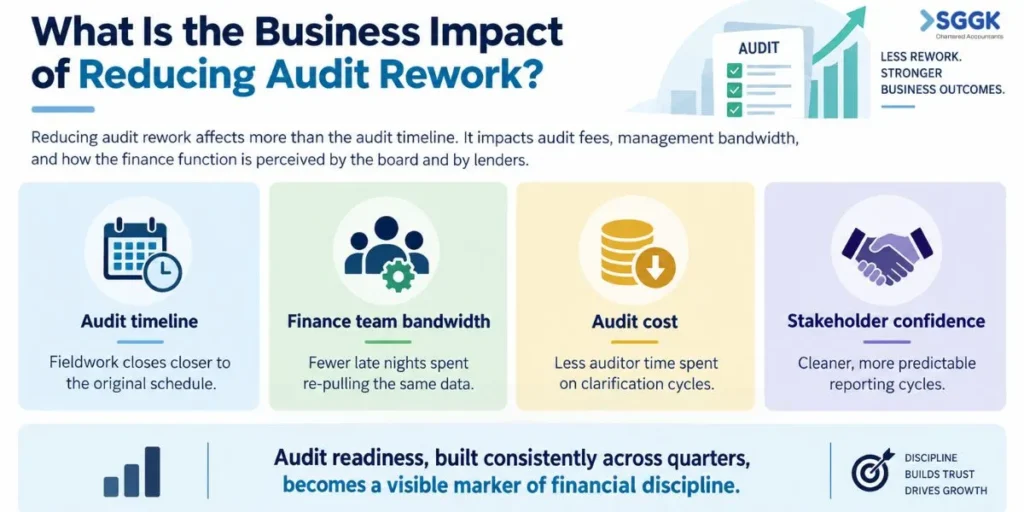
Reducing audit rework affects more than the audit timeline. It affects audit fees, management bandwidth, and how the finance function is perceived by the board and by lenders.
Impact area | Effect of reduced rework |
Audit timeline | Fieldwork closes closer to the original schedule |
Finance team bandwidth | Fewer late nights spent re-pulling the same data |
Audit cost | Less auditor time spent on clarification cycles |
Stakeholder confidence | Cleaner, more predictable reporting cycles |
Audit readiness, built consistently across quarters, becomes a visible marker of financial discipline.
Where Is Audit Preparation Heading?
Audit expectations are getting tighter, not looser. Regulators and audit committees increasingly expect faster close cycles and cleaner first-time submissions. In our experience, the finance teams coping best are already automating reconciliation checks instead of leaving them to a month-end scramble.
A few shifts worth watching:
- Real-time reconciliation tools are replacing quarter-end catch-up exercises, narrowing the window where balances drift unnoticed
- Auditors are testing continuously, not just at year-end, which rewards teams that stay audit-ready all year
- Documentation standards are converging with digital-first ERP systems, so paper trails and email approvals are becoming a liability rather than a backup
Our view:
Audit rework will keep falling for teams that treat readiness as infrastructure, not a seasonal task. Our statutory audit timeline guide covers how review cycles are compressing year over year.
Building an Audit-Ready Finance Function to Reduce Audit Rework
Audit rework is preventable. It comes from patterns finance teams can see and correct well before fieldwork starts: unreconciled balances, inconsistent documentation, slow responses, and unclear ownership, each with a specific, actionable fix, as covered above.
SGGK works with CFOs and finance controllers to build audit-ready processes ahead of the audit cycle, from PBC structuring to documentation standards. Explore our audit firm in Bangalore services for statutory, internal, and tax audit support. If your team is preparing for an upcoming audit, a readiness review can help identify gaps before your auditor does.
Strengthen Your Audit-Ready Finance Process
Frequently Asked Questions About Reduce Audit Rework
What is audit rework?
Audit rework is the repeated resubmission of schedules, reconciliations, or documents during a statutory audit, usually caused by gaps in the original submission.
Why do auditors ask the same query twice?
A repeated query means the first response did not fully close the gap, often due to missing documentation, wrong scope, or no evidence attached.
How early should reconciliations start before an audit?
Reconciliations should be substantially complete before fieldwork begins, not run in parallel with it.
Who should own PBC tracking inside a finance team?
A single coordinator should track the PBC log, while individual account owners remain responsible for the content of each item.
How is GST ITC reconciliation different from a regular balance reconciliation
It ties the books to GSTR-2B specifically, under the CGST Act, 2017, and needs to be current monthly rather than reconciled once at year-end, since ITC eligibility depends on vendor filing behaviour outside the company's control.