
What Common Audit Documentation Mistakes Delay Statutory Audits in India, and How Do You Fix Them?
Does your statutory audit always seem to run past schedule, no matter how well the books are maintained?
The most common audit documentation mistakes that delay statutory audits in India are missing supporting schedules, unreconciled balances, an incomplete audit trail, missing vouchers, and late responses to auditor queries. Each of these creates a gap the auditor cannot work around, and fieldwork stops until it is closed.
Auditors cannot sign off on assumptions. Every balance and every transaction needs proof on file before it can be accepted under SA 230. When that proof is missing, the auditor raises a query, fieldwork pauses, and the finance team is left scrambling to reconstruct information that should have been ready from the start.
This article breaks down each mistake with a practical fix, a ready audit documentation checklist, and how every gap holds up against Section 143 of the Companies Act, 2013 and Standard on Auditing (SA) 230, so finance teams know exactly what to fix first.
What Is Audit Documentation?
Audit documentation is the written proof that supports the auditor’s opinion on your financial statements. Under SA 230, it must clearly show what work was done, what evidence was checked, what conclusion was reached, and who performed and reviewed that work.
If a fact is not written down, the auditor cannot treat it as verified, and this single rule is behind most audit delays. A number can be entirely correct in your books and still get flagged during fieldwork if there is no schedule, reconciliation, or supporting bill behind it. (See ICAI’s Implementation Guide to SA 230 for the full standard.)
What Are the Most Common Audit Documentation Mistakes?
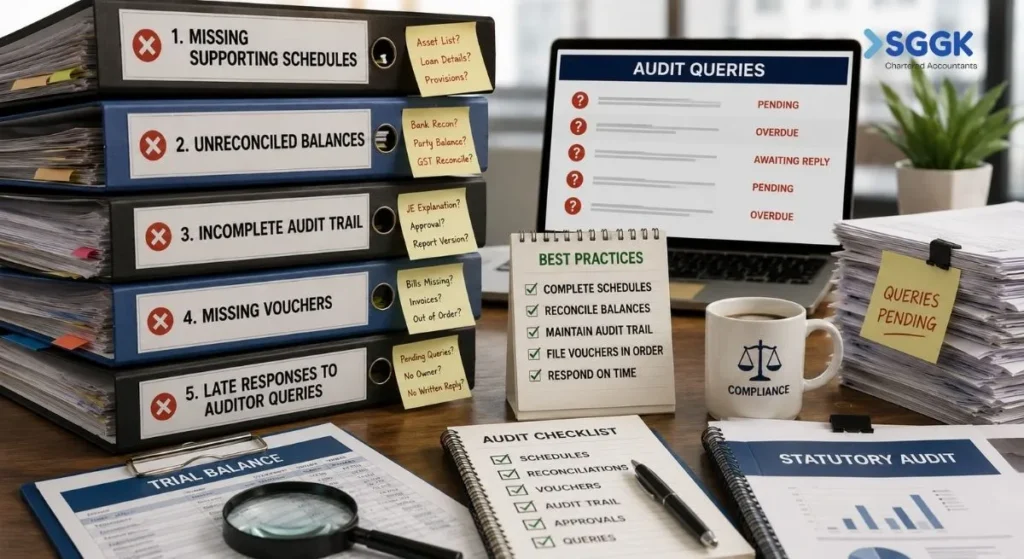
Five gaps account for most of the queries finance teams see during Indian statutory audits, and each one has a specific, preventable cause.
1. Missing Supporting Schedules
This is the number one reason for audit queries, because a number sitting in your trial balance is not proof on its own. The auditor needs to see exactly how that figure was built before accepting it.
What usually goes wrong:
- Fixed asset additions with no asset-wise list
- Loans and advances with no party-wise detail
- Provisions with no working shown
Fix: Build a schedule for every balance sheet item before the audit starts. Each schedule should match the trial balance figure exactly.
2. Unreconciled Balances
Bank balances, related-party balances, and branch balances often carry reconciliation gaps that nobody has gone back to explain.
What usually goes wrong:
- A bank reconciliation still carrying old entries nobody’s chased down
- Related-party balances that don’t agree with what the other entity has on its books
- GST returns that don’t quite tie back to the revenue number in the financials
Fix: Finish all reconciliations before the audit begins, not during it. Even the small gaps need an explanation in writing; those are usually the first thing an auditor asks about.
3. Incomplete Audit Trail
An audit trail is the chain from a bill or invoice to the final number in your financial statements. If one link is missing, the auditor has to stop and ask.
What usually goes wrong:
- Journal entries with no explanation
- Manual adjustments with no approval on file
- Reports with no date or version noted
Fix: Link every journal entry to a source document and an approval. Manual entries get the closest look from auditors, so keep those files clean.
4. Missing Vouchers
Bills and vouchers go missing more often than any other document in an audit file, especially those tied to cash expenses and reimbursements.
What usually goes wrong:
- Expense claims with no bill attached
- Purchases with no matching invoice
- Vouchers filed out of order, which slows down checking
Fix: Keep a voucher register and file vouchers in the same order as your accounting entries. This one habit saves real time during checking.
5. Late Responses to Auditor Queries
Even a well-documented file can run late if the finance team is slow to respond to auditor queries during fieldwork.
What usually goes wrong:
- Queries left unanswered for over a week
- Only one person holding all the answers
- Replies given verbally, with nothing in writing
Fix: Give one person ownership of auditor queries. Set a turnaround target, ideally 48 hours.
What Should Be on Your Audit Documentation Checklist?
Run through this list before your statutory audit begins.
Area | Documentation Required | Common Miss |
Fixed Assets | Asset-wise schedule with additions/deletions | Missing invoice reference |
Bank Balances | Reconciliation with all entries explained | Old unexplained items |
Related Party Transactions | Confirmations and board approvals | Balance mismatch with books |
Revenue | Reconciliation with GST returns | Timing differences unexplained |
Provisions | Basis of computation, working notes | No supporting calculation |
Statutory Dues | Challans and return filing proof | Late filing not disclosed |
Journal Entries | Narration and approval trail | No approval for manual entries |
If you want a second set of eyes on this before fieldwork starts, SGGK’s statutory audit support team can review your file against this exact checklist.
Which Audit Documentation Mistakes Carry the Highest Risk Under SA 230?
SA 230 asks a simple question: could another experienced auditor, with no link to this audit, understand the work just by reading the file?
The table below shows how each audit documentation mistake holds up against that test, helping you prioritise the audit evidence gaps that need fixing first.
Documentation Mistake | What SA 230 Asks For | Risk If Left Unfixed |
Missing supporting schedules | Enough evidence to support the conclusion | High: the opinion on that item can’t be formed |
Unreconciled balances | A clear basis for account balances | High: may lead to a qualified opinion |
Incomplete audit trail | A clear record of what work was done, and when | Medium: fieldwork runs longer, more queries follow |
Missing vouchers | Evidence that documents were actually checked | Medium: the sample may need to be redone |
Late query responses | A file assembled on time | Low to medium: delays sign-off, but no impact if fixed quickly |
A file that fails this test can draw closer attention during a quality review, since reviewers apply this same test when assessing an audit file.
What Do Audit Regulators Actually Find?
This isn’t just anecdotal. It shows up in the country’s own audit quality reviews, too.
India’s National Financial Reporting Authority (NFRA) inspects audit files at the country’s largest firms, and documentation keeps surfacing as one of the most persistent gaps: files that are incomplete, not clearly linked to the risks the auditor identified, or finalised too close to (or after) the sign-off date. It’s a time-pressure problem, and it shows up regardless of firm size.
Regulatory scrutiny on this is also tightening. From FY27, NFRA will inspect India’s top six audit firms and require a remediation plan for any deficiency within three months, fully implemented within six. Documentation discipline is no longer just a fieldwork convenience. It’s now on a compliance clock.
(See NFRA’s Audit Quality Inspection Guidelines for the full framework.) Documentation discipline is no longer just a fieldwork convenience. It’s now on a compliance clock.
How Much Time Do Audit Documentation Mistakes Cost?
The delays above aren’t just a process irritation; they add up into real fieldwork days. Here’s roughly how much time each mistake tends to cost on a typical Indian statutory audit.
Mistake | Typical Time Lost |
Missing schedules | 3–5 days rebuilding data |
Unreconciled balances | 2–4 days tracing differences |
Incomplete audit trail | 1–3 days per flagged entry |
Missing vouchers | Slower testing, sample may need redoing |
Late query responses | Can push sign-off back by a week or more |
These numbers vary by company size and audit scope. Treat them as a general guide, not a fixed promise.
What Should You Do Before the Audit Starts?
Once you know where the gaps usually show up, use this list to get the file ready before fieldwork begins:
- Close all reconciliations at least a week before fieldwork
- Prepare schedules for every balance sheet item in advance
- File vouchers in the same order as your accounting entries
- Give one person clear ownership of auditor queries
- Check last year’s audit queries and fix the repeat ones first
Closing these gaps before fieldwork begins can significantly reduce avoidable delays. For a practical approach to improving audit efficiency, see our guide on how to Reduce Audit Timelines.
How Do You Get Audit-Ready?
Clean documentation is built through the year, not assembled in the final week before the audit begins. The teams that avoid repeat delays are usually the ones that treat documentation as a running habit rather than a year-end scramble: schedules updated monthly, reconciliations closed as they happen, and manual entries approved and filed the same day they’re passed, instead of the same gaps piling up in the same order every audit cycle.
Talking to an audit support professional early in the financial year can help you spot these gaps before they turn into fieldwork delays, giving your team enough runway to fix root causes instead of scrambling to backfill evidence once the auditor is already on-site.
Get Your Business Audit-Ready Before Fieldwork Starts
Frequently Asked Questions About Audit Documentation
What is audit documentation, in simple terms?
It's the written proof behind an audit: the work done, the evidence checked, and the conclusion reached. SA 230 sets the rules for this, and it applies to every statutory audit under the Companies Act, 2013.
Why do statutory audits get delayed in India?
Mostly because the documentation isn't ready when fieldwork starts - missing schedules, unfinished reconciliations, gaps in the audit trail, or slow replies to auditor queries. Any one of these is enough to pause the file.
How do you stop the same audit findings from repeating every year?
Look at last year's queries before this year's audit starts, and fix those exact gaps first. This is one of the simplest ways to cut down on repeat findings.
What happens if audit documentation is still incomplete once fieldwork begins?
The auditor pauses testing on that item and raises a query, which stretches the fieldwork timeline. If the gap isn't closed in time, this can mean a redone sample, extended testing, or in serious cases, a qualified opinion. Closing gaps before fieldwork starts is what keeps sign-off on schedule.
Reduce Audit Rework: 5 Ways to Improve Audit Readiness
September 11, 2026[…] for a complete response before moving on. That wait is what stretches audit timelines. Our guide to common audit documentation mistakes breaks down the most frequent ones we see across client […]
Audit-Ready Reconciliation Framework: 2026 Guide
September 21, 2026[…] overlaps closely with what SGGK’s audit documentation research found across statutory audits that ran past schedule: the accounts weren’t wrong; they just […]