
How to Reduce Audit Timelines: Documentation, PBC Lists, and Reconciliation Cadence
A statutory audit scoped for three weeks is now heading into its sixth.
Nobody did anything wrong. The accounting was accurate. Your auditor sent the first PBC request in week one. By week three, half your team’s time is going into “can you re-send that invoice,” “which version of the TB is final,” and “who approved this journal entry.” Not into the audit itself.
That’s the real cost of weak documentation: slow answers to simple questions, repeated forty times over six weeks instead of three.
You can reduce the audit timeline by fixing three things before fieldwork starts: structure your audit files by trial balance line item, maintain a standing PBC list for audit instead of rebuilding it every year, and reconcile monthly instead of at year-end. Do this, and most of the ask-search-send-clarify loop disappears before the auditor even raises the query.
This matters most for PE-backed and VC-funded companies, where investors and boards expect signed financials on schedule. A slow audit usually signals weak documentation habits, not weak accounting.
This piece walks through what to build, in what order, and why each piece supports audit timeline reduction. It ends with a checklist for your next audit cycle.
What Drives Your Audit Timeline?
Most finance teams blame the audit timeline on the auditor. In practice, the timeline is usually set by how fast your team can respond to queries.
Every audit runs on a simple loop: the auditor asks for something, your team finds it, sends it, and the auditor reviews it. Repeat that loop 40 times with slow turnaround, and a two-week audit becomes a six-week audit.
Under the Standards on Auditing (SA 230 on Audit Documentation and SA 300 on Planning), auditors are required to build a complete, traceable file. These standards are issued by ICAI’s Auditing and Assurance Standards Board and are deemed prescribed under Section 143(10) of the Companies Act, 2013.
That requirement isn’t going away just because your documents are late. So the only variable you actually control is how fast your side of the loop moves.
The three biggest timeline killers we see:
- Documents scattered across email, WhatsApp, and shared drives
- No standing list of what auditors will ask for every year
- Reconciliations done only at year-end, in a rush
Fix these three, and you fix most of the delay.
Phase 1: Before the Audit Starts
This phase covers three fixes finance teams can put in place well before the auditor even arrives.
Structure Your Audit Files Before Fieldwork Begins
Before fieldwork, audit file organisation is the single highest-leverage fix, and it costs nothing to implement.
An unstructured audit file forces the auditor to ask “where is this” before they can even ask “is this correct?” That first question alone adds days to every audit cycle.
A structured audit file follows this logic:
Folder level | Contents | Why it matters |
1. Trial balance & financials | TB, P&L, balance sheet, cash flow | Anchors every other schedule to a single source |
2. Schedule-wise workings | One folder per financial statement line item | Matches how auditors sample and test |
3. Supporting documents | Invoices, contracts, bank statements, agreements | Grouped by schedule, not by date received |
4. Reconciliations | Bank, GST, TDS, related-party, intercompany, Revenue, Paycost. | Updated monthly, not compiled at year-end |
5. Policy & governance | Board resolutions, accounting policy notes, prior-year queries | Answers “why” before it’s asked |
Folder structure should mirror the trial balance, not your internal team structure. Auditors sample by line item, not by department.
If “Revenue” has five sub-schedules spread across three people’s laptops, that’s five separate delays waiting to happen. Assign one owner per schedule folder, and lock the structure before fieldwork starts.
A structured documentation system also helps reduce audit documentation time because evidence can be located without repeated requests.
Keep a Standing PBC List, Not a New One Every Year
A faster statutory audit rarely starts on day one of fieldwork. It starts months earlier, with a standing Prepared by Client (PBC) list that never has to be rebuilt from scratch.
Most finance teams treat the PBC list as a fresh document every year. That means re-negotiating what’s needed, re-explaining formats, and re-learning the auditor’s preferences, every single cycle.
A standing PBC list should include:
- A fixed template of every document category requested in the past two audit cycles
- The exact file format and naming convention the auditor prefers
- A responsible owner and due date against each line item
- A rolling “in progress” column your finance team updates monthly, not at audit time
A PBC list built once, properly, becomes reusable infrastructure. A PE-backed company preparing for its second audit cycle reuses last year’s list with updated dates, rather than rebuilding the document request process from scratch.
Ask your auditor for last year’s PBC list in the first week of the new financial year, not the last.
Reconcile in Real Time, Not at Year-End
Real-time reconciliation is one of the key documentation best practices audit teams ask for most and receive least.
Bank reconciliations, GST reconciliations, and intercompany reconciliations done only at year-end create a backlog that auditors have to unpack line by line. Done monthly, the same reconciliations become a five-minute confirmation.
Reconciliations that should never wait for year-end:
- Bank reconciliation statements
- GSTR-2B vs books reconciliation
- TDS receivable vs Form 26AS
- Intercompany and related-party balances
- Fixed asset register vs GL
- Revenue vs Sale Register
- Gross pay vs Pay register
Standardised documentation templates for these reconciliations also cut the risk of errors surfacing for the first time during the audit, when there’s no room left to investigate calmly.
We treat monthly reconciliation as a leading indicator of audit readiness, not a bookkeeping formality. A company with clean monthly GST and bank reconciliations rarely generates the kind of surprise finding that stalls sign-off in the final week.
Phase 2: How to Reduce Audit Timeline During the Audit
Once fieldwork begins, the goal shifts from preparation to keeping the query loop moving without adding headcount.
Streamline the Process Without Adding Headcount
Finance controllers often assume streamlining the audit means hiring more people during audit season. It usually means removing friction, not adding hands.
Three low-cost changes can improve audit fieldwork efficiency:
- One shared folder, one version. Stop emailing document versions back and forth. A single shared drive with version history removes the “which file is final” question entirely.
- A single point of contact. One person coordinating with the auditor prevents the same query being answered twice, differently, by two team members.
- A weekly query tracker. A simple sheet listing open auditor queries, owner, and status keeps nothing sitting unanswered for more than a few days.
These are process fixes, not technology investments. Assign ownership before fieldwork starts, and review the query tracker every Friday until sign-off.
Track Your Own Response Time, Not Just the Auditor’s
Auditor turnaround time cuts both ways, and finance teams rarely measure their own half of it.
Every audit query has two clocks. One tracks how long the auditor takes to raise it. The other tracks how long your team takes to respond. Most finance teams only notice the auditor’s clock. But in our experience, the client-side response clock is usually the slower one, and it’s the one you can actually control.
Track this instead of complaining about audit length:
- Average days between a query being raised and being closed
- Number of queries reopened due to incomplete first responses
- Number of queries answered by the wrong person and reassigned
A finance team that tracks its own response time for even one audit cycle usually finds the real bottleneck was never the auditor.
Phase 3: Reduce Audit Timeline by Building the Habit
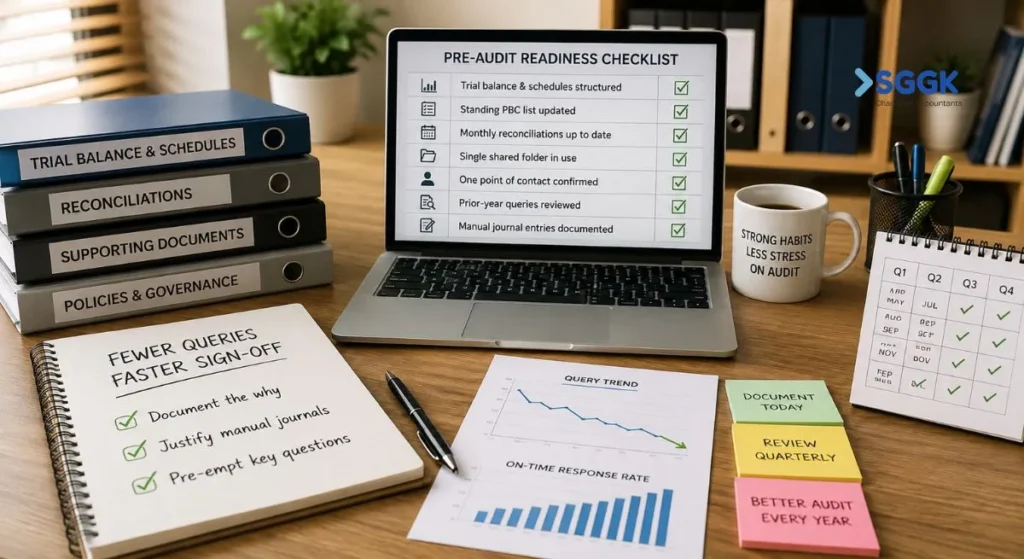
The habits built here decide whether next year’s audit starts from a stronger baseline or from scratch.
Fewer Queries Mean a Faster Sign-Off
Audit query reduction is rarely discussed as its own goal. Most teams focus on answering queries faster, not on preventing them.
But every well-documented item is a query that never gets raised in the first place. A contract filed with its board approval attached, a journal entry with its supporting note already linked, and a related-party transaction with its pricing rationale on file all remove a question before it’s asked.
A practical way to reduce query volume:
- Attach the “why” to unusual entries at the time you post them, not months later
- Keep a one-line justification note for every manual journal above your materiality threshold
- Pre-empt related-party and going-concern questions with a short internal note each quarter
This is the one habit that compounds. Fewer queries this year means a shorter, cleaner PBC list next year.
Pre-Audit Readiness Checklist
Use this before fieldwork begins, not once it has already started.
- Trial balance and schedules structured by financial statement line item
- Standing PBC list updated with this year’s owners and dates
- Monthly reconciliations current through the last closed month
- Single shared folder in use, no email attachments as source of truth
- One point of contact confirmed with the audit team
- Prior-year audit queries reviewed and pre-empted where possible
- Manual journal entries above materiality documented with rationale
Pre-audit readiness is not a one-week sprint before fieldwork. It is a habit built across the year, checked quarterly.
What's Different for PE-Backed and VC-Funded Companies in India?
Funded companies carry a few extra documentation needs. ESOP grants under Section 62(1)(b) of the Companies Act need the special resolution, scheme rules, and, at exercise, a Registered Valuer’s report.
Auditors will also want the grant-date valuation assumptions on file under Ind AS 102, not reconstructed later. Related-party transactions with promoters or group entities need a pricing rationale documented under Ind AS 24 at the time, not just board minutes after the fact. File both in “Policy & Governance” as they happen, and they answer the auditor’s question before it’s asked.
Closing Thought: How to Reduce Audit Timeline Consistently
None of this requires new software or a larger finance team. It requires deciding, once, how your documentation will be organised, and holding that structure every month, not just in audit season.
SGGK works with finance teams at PE-backed and VC-funded companies to set up exactly this kind of audit support services in Bangalore: structured files, standing PBC templates, and reconciliation cadences, so the audit itself becomes the shortest part of the process. If your team is planning for this year’s audit cycle, a conversation with our audit support team is a reasonable place to start.
Prepare for a Smoother Audit
Frequently Asked Questions About Reduce Audit Timelines
How early should we start audit-readiness work?
Ideally at the start of the financial year, not the month before fieldwork. Monthly reconciliation and folder structure take minutes to maintain but hours to rebuild retroactively.
Does better documentation actually reduce audit fees?
Documentation quality affects fieldwork time more directly than fees, since fee structures vary by engagement. Shorter fieldwork does, however, reduce the internal team hours your finance staff spend supporting the audit.
Who should own the PBC list internally?
One senior finance team member, ideally the controller or a designated audit coordinator, should own the master list, even if individual line items are delegated.
Does this apply to first-time audits as well as recurring ones?
Yes, First-time audits benefit even more from structured files, since there is no prior-year file to draw on. Building the structure early saves the most time in year one.
How Can You Reduce Audit Documentation Time?
You can reduce audit documentation time by organising files by financial statement line item, using standardised templates, maintaining version control, linking supporting evidence and documenting significant transactions when they occur rather than reconstructing them during fieldwork.
How Can Finance Teams Reduce Audit Prep Time?
Finance teams can reduce audit prep time by maintaining a standing PBC list, completing reconciliations monthly, organising supporting documents throughout the year and reviewing prior-year audit queries before the next audit cycle.
How Do Audit Teams Manage Fieldwork More Efficiently?
Audit teams can manage fieldwork more efficiently through a central PBC tracker, clear ownership of audit requests, a single source for supporting documents, regular query reviews and timely responses from the finance team
Audit Documentation: Common Mistakes That Delay Audits
September 1, 2026[…] Closing these gaps before fieldwork begins can significantly reduce avoidable delays. For a practical approach to improving audit efficiency, see our guide on how to Reduce Audit Timelines. […]
Audit-Ready Reconciliation Framework: 2026 Guide
September 21, 2026[…] caught and explained while the transaction is still fresh, not five months later during fieldwork. SGGK’s research on audit timelines found that reconciliation cadence, more than headcount, was the variable that separated audits […]