Audit Preparation for Startups: A Pre-Fieldwork Checklist for Newly Funded Companies
The majority of startups do not prioritise audit readiness until a funding round renders it unavoidable. Once investors and board members are involved, they anticipate financial reporting that is capable of withstanding scrutiny, rather than technically accurate records.
Founders are focused on product development, hiring, and customer acquisition after the funding round, so reconciliation and documentation work tends to slip quietly down the priority list. Disorganised records and missing approvals are what end up slowing down audit coordination later.
At SGGK, we have helped early-stage and Series A startups across Bangalore transition from founder-led finance operations to audit-ready finance functions that meet investor and statutory expectations.
This checklist covers audit preparation for startups, outlining what we ask every newly funded client to have in place before fieldwork begins.
What Auditors Actually Check First?
First-time startup audits rarely slow down because of complex accounting. They slow down because the cap table does not tie back to the PAS-3 filings on record with the RoC, and journal entries carry no narration explaining the business reason behind them. Both are checked in the first hour of fieldwork, before the PBC list is even opened, because a gap in either one signals that other reconciliations were probably skipped too.
A typical example we see: a seed-stage startup has its bank reconciliations current and its statutory filings up to date, but its ESOP pool was priced informally, with no valuation report behind the numbers used for expensing. The gap is the missing paper trail behind the fair value figure, and it’s exactly the kind of thing that surfaces in the first hour of fieldwork.
Why Audit Readiness Becomes a Priority After Funding?
Raising external funding changes what’s expected of your startup’s finance function. Investors and statutory auditors don’t just want accurate books, they want records that can be verified when someone asks. That’s a different bar than closing the books each month. It means financial transactions and governance records need to hold up on their own, without you having to explain or reconstruct them after the fact.
When the documentation auditors need isn’t ready at the start of fieldwork, they don’t just wait. They expand testing, ask for more evidence, and hold off on completion until they have enough to work with. That has a real cost: more time pulled from management, a longer timeline overall, and sometimes a delayed audit report.
A structured audit-preparation process for startups helps finance teams identify gaps before the audit starts. If you’re new to the concept, read our guide on What Is Audit Readiness to understand the processes, documentation, and controls auditors expect before fieldwork begins. Reviewing financial statements, compliance records, and reconciliations in advance is what actually gets startups audit-ready, and it’s what lets them meet the expectations that come with external funding.
How Long Does Audit Preparation For Startup Usually Take?
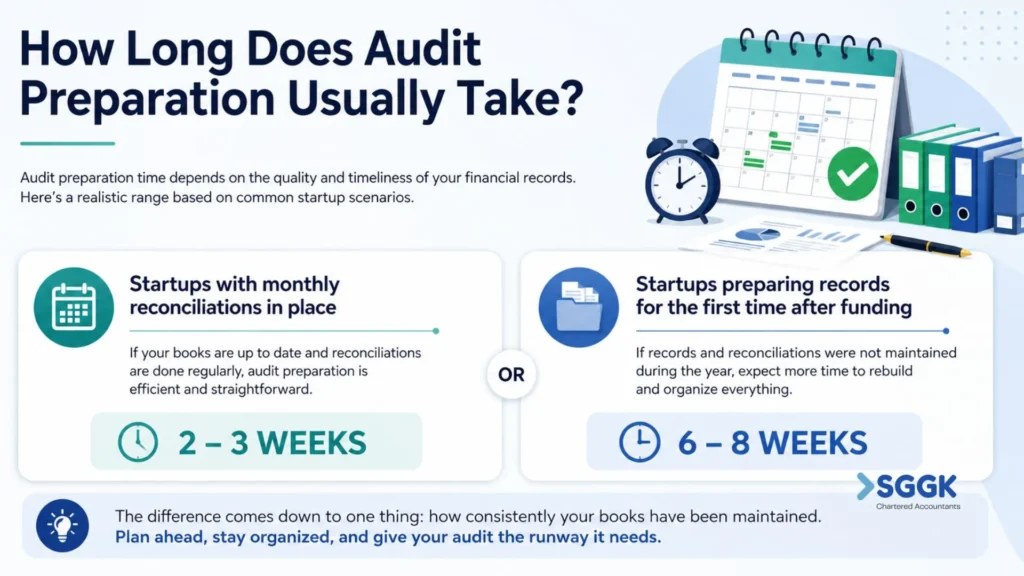
For startups with monthly reconciliations already in place, audit preparation typically takes two to three weeks. For those preparing these records for the first time after funding, it commonly stretches to six to eight weeks, driven mainly by rebuilding a year’s worth of bank and vendor reconciliations that were never done as they went.
That’s the range founders should plan around when they ask their team, or SGGK, how much runway an audit needs.
Why Supporting Documents Matter in Audit Preparation for Startups?
Many startup founders believe auditors ask for excessive documentation. In reality, every document supports one or more audit assertions. Once finance teams understand what auditors are trying to verify, preparing evidence becomes significantly easier.
| Audit Objective / Auditor Checks | Evidence Requested |
|---|---|
| Does this asset exist? | Invoice, Fixed Asset Register |
| Did this revenue actually occur? | Customer Agreement, Sales Order (SO) / Purchase Order (PO), and Sales Invoice |
| Is this expense genuine? | Vendor Invoice and Approved Payment/Expense Authorisation |
| Was this funding legally issued? | PAS-3, Board Resolutions, and FC-GPR (for Foreign Investments) |
Financial Statements Checklist for Effective Audit Preparation for Startups
A key part of audit preparation for startups is that before audit fieldwork begins, your financial statements should already be internally reviewed, finalised, and supported with appropriate documentation.
1. Core Financial Records
| Document | Purpose |
|---|---|
| Trial Balance for the Audit Period | Base for financial statement review and audit planning |
| General Ledger | Contains all transactions recorded and classified under each account |
| Financial Statements | Prepared in accordance with Schedule III of the Companies Act, 2013 (where applicable) |
| Notes to Financial Statements | Provide supporting schedules, accounting policies, and required disclosures |
| Previous Audit Report and Management Letter | Helps review prior-year observations, recommendations, and continuity of audit findings |
These records form the foundation of the auditor’s examination.
2. Fundraise and Cap Table Documents
This is where first audits for funded startups differ from a standard audit. Auditors dig into funding-related transactions specifically because they touch ownership and financial reporting in ways that go straight to what investors expect from a funded startup’s audit.
| Document | Why It Matters |
|---|---|
| Share Subscription Agreement | Confirms the terms and conditions of the funding round |
| Shareholders’ Agreement | Verifies the rights, obligations, and protections attached to the shares issued |
| Board and Shareholder Resolutions | Approves the share allotment and authorizes the transaction |
| Valuation Report (where applicable) | Required under the Companies Act, FEMA, or transaction-specific terms to support the issue price |
| Form PAS-3 | Filed with the Registrar of Companies (RoC) to confirm the share allotment |
| FC-GPR Filing with RBI | Mandatory for reporting foreign investment under FEMA regulations |
| Updated Capitalisation Table (including ESOP Pool) | Confirms the current ownership structure and equity distribution |
One gap that surfaces often in pre-Series A startups: ESOP options were granted before any formal valuation report existed to support their fair value. If the exercise price and fair value used for ESOP expensing aren’t backed by a valuation report, auditors will flag the equity compensation entries as unsupported. Get a valuation done for those grants before fieldwork begins, not during it.
3. Corporate Documents Checklist
Keep these documents organised and easy to pull up:
- Certificate of Incorporation and CIN
- Memorandum and Articles of Association
- Company and director PAN details
- GST registration certificate
- Business licenses relevant to your operations
- Material customer agreements
- Vendor agreements
- Loan agreements
A centralised repository for all of this saves you from chasing down files mid-audit, which is where a lot of unnecessary follow-ups come from.
4. Statutory Compliance Checklist Before the Audit
Investors and auditors review whether your startup has maintained its key statutory compliances on time. Miss a filing or file it late, and expect more questions from your auditor, along with extra review before they’ll sign off.
Review:
a. Corporate Compliance
- AOC-4: files the company’s audited financial statements with the Registrar of Companies
- MGT-7: annual return covering shareholding, directors, and other statutory details
- DIR-3 KYC: annual KYC filing that keeps directors’ DIN active
- ADT-1: files the auditor’s appointment with the RoC
b. Tax Compliance
- TDS returns (Form 24Q and 26Q), reconciled with challans
- GST returns (GSTR-1, GSTR-3B, GSTR-9 where applicable), reconciled with books
- Income tax return filed for the relevant assessment year
c. Other Compliance Areas
- PF and ESI returns, where applicable
- FEMA and RBI documentation for foreign investment transactions
- Significant Beneficial Ownership – BEN Forms where applicable
- Required license from the regulatory authorities
5. Reconciliation Checklist Every Finance Team Should Complete
Unreconciled accounts are one of the most common reasons a first-time audit drags on with extra follow-ups.
a. Bank Reconciliation
Have monthly statements ready for the full audit period. Review outstanding cheques, chase down any unidentified deposits, and make sure foreign currency transactions were recorded at the right exchange rates at the time.
b. Accounts Receivable
Go through customer outstanding balances and confirm the major ones where needed. Any write-offs should have approvals attached, and customer advances should actually match what’s still owed.
c. Accounts Payable
Reconcile vendor statements against your books. Match what’s been received against what’s still outstanding, and clear up any long-pending advances instead of leaving them unexplained.
d. GST Reconciliation
Match GSTR-2B against your purchase records, reconcile Input Tax Credit, and make sure the Electronic Credit Ledger balance as per the GST portal actually ties back to the books.
6. Ledger Clean-Up and Internal Controls
A clean general ledger makes the audit processes more efficient.
Before fieldwork begins: clear suspense account balances, close pending ledger items that no longer apply, reconcile intercompany balances where applicable, and ensure manual journal entries carry clear narrations and supporting documents. Update the fixed asset register with purchase date, cost, and depreciation.
You probably don’t need a fully built-out ICFR framework this early. But investors and auditors still expect the basics: someone has to approve significant payments before they go out, and ideally, the person recording a transaction isn’t the same person approving it, at least wherever that’s practical for a small team.
7. Prepare the Auditor’s PBC (Prepared By Client) List
Before audit fieldwork begins, auditors generally provide a Prepared By Client (PBC) list containing documents and schedules required for testing. Preparing these items early improves audit coordination.
Common PBC requirements include:
- Trial Balance
- General Ledger
- Bank reconciliation statements
- Fixed asset register
- Accounts receivable ageing
- Accounts payable ageing
- GST reconciliation
- TDS reconciliation
- Loan schedules
- Investment schedules
- Payroll records
- Major customer and vendor agreements
When Should Startups Begin Audit Preparation? The SGGK Readiness Timeline
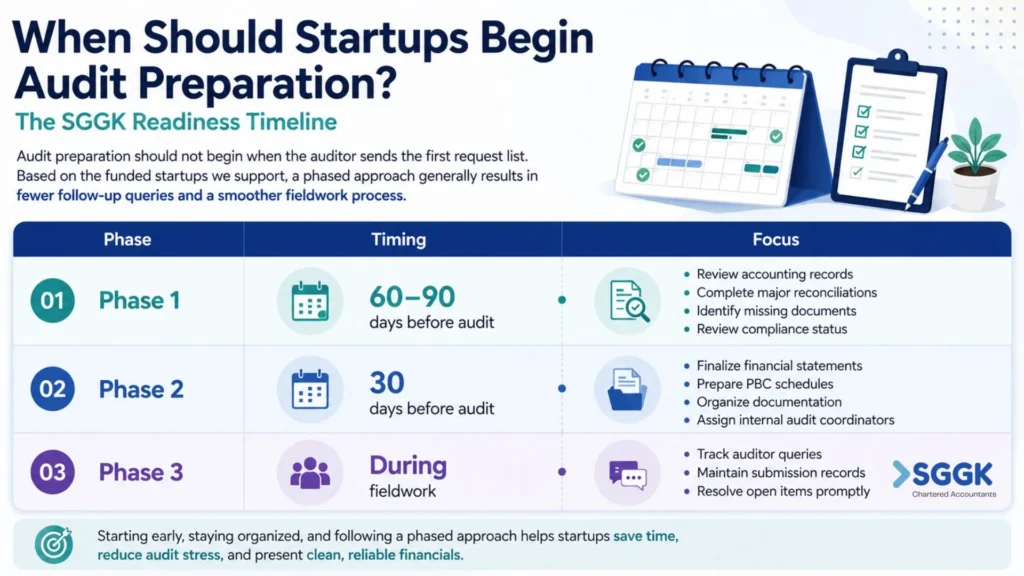
Audit preparation should not begin when the auditor sends the first request list. Based on the funded startups we support, a phased approach generally results in fewer follow-up queries and a smoother fieldwork process.
| Phase | Timing | Focus |
|---|---|---|
| Phase 1 | 60–90 days before the audit | Review accounting records, complete major reconciliations, identify missing documents, and assess compliance status |
| Phase 2 | 30 days before the audit | Finalise financial statements, prepare PBC (Prepared by Client) schedules, organise supporting documentation, and assign internal audit coordinators |
| Phase 3 | During audit fieldwork | Track auditor queries, maintain records of document submissions, and resolve open audit items promptly |
Common Mistakes That Delay a Startup’s First Audit
First audits for startups become longer because of avoidable preparation gaps that could have been identified during pre-audit preparation. Common issues include:
- Waiting until fieldwork begins to organise funding documentation
- Leaving statutory registers, such as the Register of Members, incomplete
- Missing approvals for related-party transactions
- Skipping monthly reconciliations
- No clear owner for audit coordination
- Mixing personal and business expenses
- Recording revenue too early or without sufficient documentation
- Cap table entries that don’t reconcile to the PAS-3 filings on record with the RoC
Each issue may appear small individually. But as noted earlier, a cap table that doesn’t tie back to PAS-3 filings is usually the first sign that other reconciliations were skipped too. And together, these gaps can turn a straightforward audit into weeks of additional follow-ups
Getting Audit Ready Is a Habit, Not a Deadline
Strong audit preparation for startups is not only about completing an annual compliance exercise. It sets the tone for how investors view your company’s financial discipline going forward. Founders who treat audit readiness as an ongoing habit consistently get cleaner reports and fewer follow-up queries than those who treat it as a once-a-year scramble.
So ask yourself again:
If your auditor walked in tomorrow, how much of this checklist would already be done?
Need Support With Your Startup’s Audit Preparation?
Not sure where your startup actually stands on audit readiness? SGGK can help you find the gaps and tighten up your preparation process.
We work with early-stage and Series A startups on financial reporting, reconciliation support, compliance reviews, audit documentation, and audit coordination.
Through our audit support services in Bangalore, we help startups get their records organised so auditors can start fieldwork with better visibility and fewer gaps to chase down.
Whether your first audit is coming up or you’re just trying to build a stronger finance function before the next funding round, our team can help you put the right processes in place for the long run.
Audit Preparation for Startups: Pre-Audit Checklist
FAQs About Audit Preparation For Startups
What happens if my startup misses AOC-4 or MGT-7 filing deadlines?
Late filing attracts a daily penalty with no upper cap, and non-filing for three consecutive financial years can lead to director disqualification under Section 164(2). It also raises red flags for auditors and investors reviewing your compliance history.
Do I need a valuation report for every funding round?
A valuation report is typically required under the Companies Act, FEMA, or the specific terms of the transaction. Check the SSA/SHA for the round to confirm.
Can I start audit preparation before my auditor sends the PBC list?
Yes, and you should. Waiting for the PBC list before organizing records is one of the most common reasons first-time startup audits run long.
Does a small startup need a full ICFR framework before its first audit?
Not usually. Investors and auditors expect basic controls like an Approval Matrix (like: payment approvals, Invoice and PO approvals) and separation of recording/approving duties where practical, not a fully built-out framework at this stage.
How to Reduce Audit Timeline Through Better Documentation ?
October 6, 2026[…] Before fieldwork, audit file organisation is the single highest-leverage fix, and it costs nothing to implement. […]