Statutory Audit Checklist For CFOs: What To Have Ready Before The Auditor Arrives
If your company’s statutory auditor is walking in next month, the real question is whether your books, reconciliations, and compliance records are ready before they ask. Under the Companies Act, 2013, every company registered in India, private, public, or a One Person Company, must get its accounts audited every year. This applies regardless of turnover or whether the company was active.
Statutory audits in India typically take three to eight weeks to complete, depending on company size and how audit-ready the documentation is. Where a company lands within that range comes down to how many of its procedural gaps were closed before the auditor had to find them.
This statutory audit checklist lays out exactly what to keep ready, in what order, and why each item matters.
What Statutory Audit Actually Checks, And Why Preparation Changes The Outcome?
A statutory audit is an independent examination of your financial statements by a practising Chartered Accountant. If you’re unsure how it differs from an internal audit, read our guide on Internal Audit vs Statutory Audit. Its purpose is to confirm that the statements present a true and fair view of the company’s financial position. It is not optional, and it is not scaled by size.
Sections 139 to 148 of the Companies Act, 2013 govern auditor appointment, eligibility, rights, and duties. Standards on Auditing issued by ICAI, such as SA 315 (risk identification), SA 500 (audit evidence), and SA 230 (audit documentation), govern how the auditor conducts the work.
Here is the part most CFOs underestimate: auditors do not spend most of their time auditing. They spend it waiting. Waiting for a reconciliation. Waiting for a missing invoice or a clarification on a related-party transaction.
Every day spent waiting is a day added to the audit timeline. Preparation is not paperwork for its own sake. It is one of the biggest levers a CFO has over how long the audit takes.
The Statutory Audit Checklist: What To Prepare Before Fieldwork Begins
Group your preparation into the categories your auditor will actually work through. This is broadly the sequence a competent audit team follows, so preparing in this order reduces the number of back-and-forth queries.
1. Financial statements and core books
Document | Why the auditor needs it |
Roll-forward of opening balance | Opening balance is an audited balance. |
Trial balance and general ledger | Base for verifying arithmetical accuracy and classification |
Balance sheet, Profit & Loss, Cash Flow Statement | The financial statements under audit |
Notes to accounts and accounting policies | Confirms disclosures match Accounting Standards requirements. |
Subsidiary ledgers (debtors, creditors, inventory) | Supports balance-level verification |
Fixed asset register with additions and disposals | Verifies existence, ownership, and depreciation |
Physical verification records for inventory and fixed assets | Supports the existence assertion beyond ledger balances |
Prior year’s audited financials and audit report | Confirms opening balances and closes out earlier audit observations |
A trial balance that does not tie out to the ledger is a common reason audits stall in week one. Reconcile this before the auditor asks for it, not after.
2. Reconciliations
- Bank reconciliation statements for every account, for the full year
- GST reconciliation between books, GSTR-1, GSTR-3B, and GSTR-2B
- TDS reconciliation between books and Form 26AS
- Inter-company and related-party balance confirmations
- Reconciliation of Trade receivables and payables with vendor statements.
A GST mismatch between your books and GSTR-2B is not just a compliance issue. It signals to the auditor that revenue or input credit may need deeper testing. That extends fieldwork, so resolve these gaps before fieldwork starts, not during it.
3. Statutory and compliance documents
Category | Documents to keep ready |
Corporate filings | Copies of all ROC filings made during the year, board and shareholder resolutions |
Tax compliance | GST returns, TDS returns, advance tax challans, income tax, deferred tax computation along with Effective Tax Rate reconciliation. |
Labour compliance | PF, ESI, and professional tax returns with payment proof, matched against the challans reconciled in Section 2 |
Contracts and legal | Loan agreements, lease deeds, litigation status, contingent liability details with supporting documents |
Related party transactions | List of related parties for the year, with board approvals where applicable, supporting the balance confirmations in Section 2 |
4. Audit trail and edit log documentation
This is where most checklists stop short, and it is worth CFOs paying close attention to.
Under Rule 3(1) of the Companies (Accounts) Rules, 2014, companies using accounting software must use software with a built-in audit trail. This has applied since financial years commencing on or after 1 April 2023. The software must record every transaction. It must log every edit made to the books, along with the date. The audit trail feature must not be capable of being disabled.
Under Rule 11(g) of the Companies (Audit and Auditors) Rules, 2014, your statutory auditor must now report on this specifically. The auditor confirms whether the feature exists and was active all year. They also confirm whether it was tampered with or preserved.
In practical terms, a CFO should be ready with:
- Confirmation that the audit trail feature was enabled for the full year, not just from the date IT noticed the requirement
- An exported audit trail or edit log report for the financial year
- Confirmation that books maintained in electronic mode, including any backups kept outside India, are also backed up on servers physically located in India daily, as required under Rule 3
If your software cannot produce this, or the feature was switched off for part of the year, expect this to surface as a qualification in the audit report.
5. Board, AGM and other documentation
- Minutes of board meetings, shareholder meeting, CSR meetings held during the year
- Board approval of financial statements before the AGM, at a properly convened meeting with physical quorum for this specific item
- Directors’ Report and Directors’ Responsibility Statement
- CARO 2020 applicability assessment, where relevant to the company
- Signed Management Representation Letter, confirming management’s responsibility for the financial statements and disclosures
ICAI’s Quality Review Board has flagged 47 recurring non-compliances in statutory audits – mostly procedural gaps in documentation, CARO reporting, and internal financial controls, not misstatements or fraud
Why Audits Get Delayed Even When Documents Are Ready ?
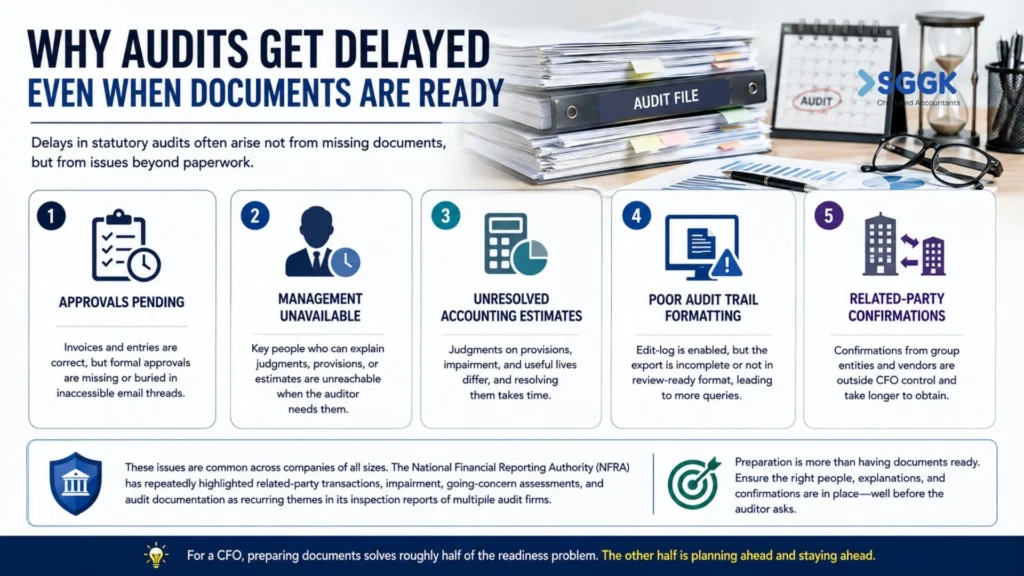
Most statutory audit checklists stop at “keep the documents ready.” That is necessary, but it is not sufficient. A fully documented file does not, on its own, guarantee a fast audit. Delays tend to cluster around five triggers unrelated to missing paperwork.
Approvals pending.
The invoice exists, and the ledger entry is correct, but the sign-off that authorises it was never formally recorded, or it sits in an email thread the auditor cannot access.
Management unavailable.
The one person who can explain a judgment call, a provision, an estimate, a revenue-recognition decision, is unreachable during the exact week the auditor needs the answer.
Unresolved accounting estimates.
Provisioning and impairment assessments involve judgment, not verification, and useful-life estimates are no different. When finance and the auditor read the same facts differently, resolving that takes discussion.
Poor audit trail formatting.
The edit-log feature may be switched on, but if the export does not cover the full year or is not formatted for review, the auditor still has to chase clarifications.
Related-party confirmations.
Confirmations from group companies and vendors sit outside the CFO’s direct control. They are one of the slower-moving items in any audit file.
This pattern is not confined to smaller or less-organised companies. India’s audit regulator, the National Financial Reporting Authority, has flagged related-party transactions, impairment, going-concern assessments, and audit documentation as recurring themes. These findings span its inspection reports of multiple audit firms, including some of the largest in the country.
For a CFO, preparing documents solves roughly half of the readiness problem. The other half is making the right person available to explain judgment calls during fieldwork, and chasing related-party confirmations weeks in advance rather than after the auditor flags them missing.
What Do Auditors Actually Query Most, And How Should CFOs Pre-Empt It?
Every audit team fields a familiar set of questions. Preparing answers to these before fieldwork begins removes an entire category of delay.
1. Why does this expense not have supporting documentation?
Every material expense should have an invoice and an approval trail. Payment proof should be filed in a way that can be pulled up on request.
2. Why is this related-party transaction not disclosed?
Build your related-party list at the start of the year, not at audit time, and update it as transactions occur.
3. Why does the bank balance in your books not match the statement?
Monthly reconciliations, not a single year-end reconciliation, catch discrepancies while they are still explainable.
4. What is the basis for this provision or contingent liability?
Keep the calculation and the legal opinion, if any, documented alongside the accounting treatment.
When Should CFOs Start Preparing?
Statutory audit timelines in India are anchored to fixed dates. Preparation needs to start well before the auditor’s first visit.
Milestone | Typical timeline (FY ending 31 March) |
Books closing and internal reconciliations | April to May |
Auditor fieldwork and query resolution | May to August |
Board approval of audited financials | 4 to 6 weeks before AGM |
Annual General Meeting | On or before 30 September |
Filing of financial statements (Form AOC-4) | Within 30 days of AGM |
Filing of annual return (Form MGT-7) | Within 60 days of AGM |
Auditor appointment filing (Form ADT-1) | Within 15 days of AGM |
Starting book closure only after the auditor’s team arrives is what pushes most companies past their September AGM deadline. Working backward from 30 September, most companies need reconciliations substantially complete by end-May. That leaves adequate time for fieldwork and board approval.
What Happens If You Are Not Audit-Ready?
Delayed audits carry consequences beyond a longer fieldwork period. Miss the AGM deadline, and the company can be penalised up to ₹1 lakh. If the default continues, that adds ₹5,000 a day under Section 99, and the officers in default become personally liable too.
Filing Form AOC-4 or MGT-7 late costs an extra ₹100 a day, with no cap on how high that can go. Directors attract disqualification if the company has not filed financial statements or annual returns for any continuous period of three financial years.
Beyond the financial penalty, a delayed or qualified audit report can affect lender covenants and investor reporting timelines. In some cases, it can also affect the company’s standing with regulatory authorities.
None of this is inevitable. It is a direct function of how early, and how completely, the finance team prepares before the auditor’s first day on site.
Statutory Audit Checklist: Final Takeaways for CFOs
For a CFO, audit readiness is not just a compliance box to tick. It is what lets lenders and investors, right through to the Board, rely on your numbers without asking for a revision.
Three things move the needle most: monthly reconciliations instead of a year-end scramble, an audit trail export that actually covers the full year, and the right person available to explain judgment calls when the auditor asks. Get these right, and the audit sits at the shorter end of the three-to-eight-week window, not the longer one.
SGGK’s audit support services in Bangalore, led by Chartered Accountants with Big 4 audit backgrounds, can run a pre-audit readiness review to flag these gaps before your statutory auditor’s first visit.
Get Your Statutory Audit Readiness Reviewed
FAQs About Statutory Audit Checklist
How long before the AGM should audit preparation begin?
Most companies with a 31 March year-end should have reconciliations and supporting documentation substantially ready by end-May.
Does a dormant or zero-transaction company still need a statutory audit?
Yes, under the Companies Act, 2013, every company must be audited annually, whether it has a high turnover or very few transactions recorded that year.
What is the difference between a statutory audit and an internal audit?
The statutory audit is a mandatory, independent check carried out under the Companies Act. Internal audit, by contrast, looks at a firm's own processes and controls, and management drives it. One doesn't substitute for the other.
Audit Support Services for MNCs | Multi-Entity Audits
September 25, 2026[…] same structured approach also helps during statutory audits for individual entities, not just the […]