
GST Audit Manual: A Practical Guide to GST Audit Preparation, Reconciliation and Documentation
Where a client with Indian operations is served a Section 65 notice under the CGST Act, 2017, the engagement team’s starting point should be the GST Audit Manual. The Model All India GST Audit Manual 2023 is drafted for tax officers, so it reveals what they will scrutinise and the sequence they follow.
This guide is intended for audit partners, audit managers and engagement teams at US CPA and accounting firms that support clients with Indian subsidiaries or vendors and need to understand the process without becoming GST specialists. Read it once end to end, then keep the tables as a working reference during fieldwork.
Key Takeaways
- The GST Audit Manual guides officers. The manual is guidance for officers, while the CGST Act and Rules bind taxpayers. Use it as a preview of departmental thinking, not as law.
- A departmental audit begins with a notice in Form GST ADT-01, issued at least 15 working days in advance.
- Sound GST audit preparation treats reconciliation as a chain: books, GSTR-1, GSTR-3B, GSTR-2B and GSTR-9.
- Since GSTR-2B now governs the credit a taxpayer can claim, ITC mismatches should be resolved prior to filing and not left for later.
- FY 2025-26 straddles two rate structures, so the first test should be whether tax invoices carry the correct rate.
- GSTR-9 and GSTR-9C for FY 2025-26 are due 31 December 2026.
What Is the GST Audit Manual, and Why Does It Matter to Engagement Teams?
The Model All India GST Audit Manual 2023 was prepared by the Committee of Officers on GST Audits and is hosted on the GST Council website. It addresses selection, desk review, conduct of the audit, findings and follow-up. Its annexures include an auditee questionnaire and lists of the books of account and statements that officers request.
The most useful way to read it is from the auditee’s side, as each stage indicates what you should already have in place.
Manual stage | What the officer does | What your team should have ready |
Desk review (Chapter 4) | Studies returns, financials and ratios before visiting | Trend and ratio analysis of turnover, ITC and tax paid, with explanations |
Commencement (Chapter 5) | Calls for records and raises queries | A catalogued record set, one named liaison, and a log of every query raised |
Findings (Chapter 5) | Shares discrepancies and a draft audit report | Draft replies with supporting documents |
Final report (Chapters 5-6) | Issues findings; demand may follow | An escalation path for Section 73, 74 or 74A exposure |
Special cases (Chapter 7) | Handles cancelled registrations or seizures | Registration and change-of-status file |
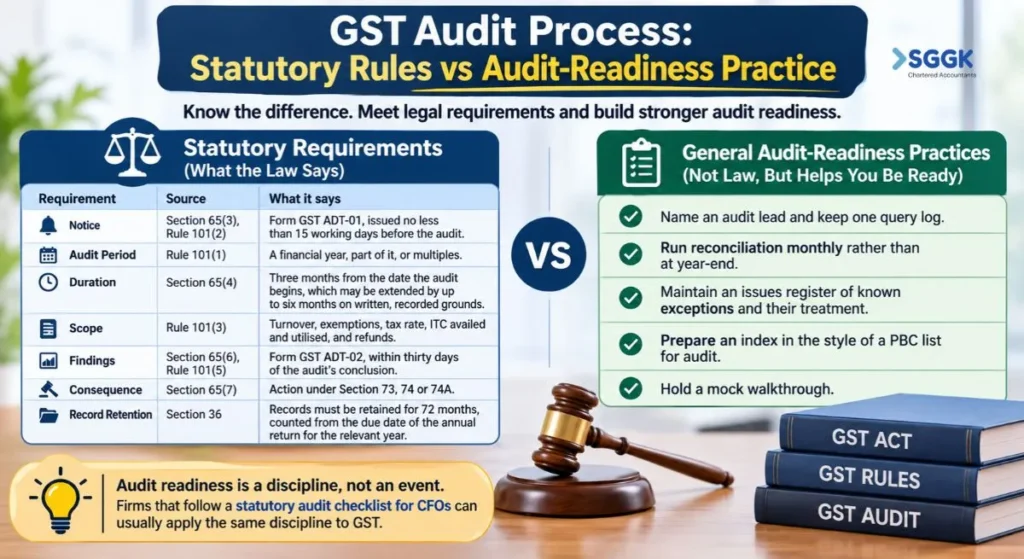
GST Audit Process: Statutory Rules vs Audit-Readiness Practice
The most frequent planning mistake is to treat legal obligations and good habits as one and the same, so handle them separately. The distinction matters because an officer can enforce the first group, whereas the second only lets you respond faster and with stronger evidence.
Statutory requirements
Requirement | Source | What it says |
Notice | Section 65(3), Rule 101(2) | Form GST ADT-01, issued no less than 15 working days before the audit |
Audit period | Rule 101(1) | A financial year, part of it, or multiples |
Duration | Section 65(4) | Three months from the date the audit begins, which the Commissioner may extend by up to six months on written, recorded grounds |
Scope | Rule 101(3) | Turnover, exemptions, tax rate, ITC availed and utilised, and refunds |
Findings | Section 65(6), Rule 101(5) | Form GST ADT-02, within thirty days of the audit’s conclusion |
Consequence | Section 65(7) | Action under Section 73, 74 or 74A |
Record retention | Section 36 | Records must be retained for 72 months, counted from the due date of the annual return for the relevant year |
General audit-readiness practices (not law)
- Name an audit lead and keep one query log.
- Run reconciliation monthly rather than at year-end.
- Maintain an issues register of known exceptions and their treatment.
- Prepare an index in the style of a PBC list for audit.
- Hold a mock walkthrough.
Audit readiness is a discipline, not an event. Firms that already apply a statutory audit checklist for CFOs can usually carry the same discipline over to GST.
GST Audit Checklist: Records to Organise Before the Notice Arrives
Strong GST audit documentation starts with GST records that can be produced in hours, not weeks.
Record group | Examples | Basis |
Outward supplies | Tax invoices, credit and debit notes, e-invoice data, e-way bills | Statutory |
Inward supplies | Purchase tax invoices, bills of entry, self-invoices for reverse-charge supplies, and proof of payment | Statutory (ITC conditions) |
Returns | GSTR-1, GSTR-3B, GSTR-9, GSTR-9C with ARNs | Statutory |
Ledgers | Electronic cash, credit and liability ledgers | Statutory (portal) |
Books of accounts | General ledger, trial balance, sales and purchase registers | Statutory (Section 35) |
Reconciliation workings | Monthly tie-outs and the reconciliation statement | Practice (GSTR-9C is statutory) |
Policy notes | ITC eligibility memo, blocked-credit list, valuation notes | Practice |
Vendor file | GSTIN validation, filing status, contracts | Practice |
Startups can adapt this list using the pre-fieldwork checklist for newly funded companies.
GST Reconciliation: Connecting Books of Accounts to GST Returns
GST reconciliation is where most audit queries originate, because each check an officer performs traces a return figure back to your books of accounts. Doing it in a fixed sequence, and logging each difference, turns scattered tie-outs into evidence a reviewer can follow. The two parts below set out the sequence and then a worked example.
The five-link reconciliation chain
Reconcile GST returns in sequence. A break at link one repeats at every later link. This chain is SGGK’s working framework, not a statutory format.
Link | Compare | Frequent break |
1 | Books of accounts vs GSTR-1 | Missed credit notes, unbilled revenue |
2 | GSTR-1 vs GSTR-3B (Tables 3.1 and 3.2) | Timing and amendments |
3 | Purchase register vs GSTR-2B | Supplier not filed, wrong GSTIN |
4 | GSTR-3B Table 4 vs GSTR-2B | Excess claim, missed reversals |
5 | GSTR-9 vs financial statements | Turnover differs from audited revenue |
Since the July 2025 tax period, Tables 3.1 and 3.2 of GSTR-3B are non-editable. Outward errors are corrected through GSTR-1A before filing, as this September 2026 GST review explains. That makes link one more important than before.
Illustrative example (hypothetical figures)
Item | ₹ lakh |
Turnover per audited books | 1,250 |
Less: receipts outside GST (interest, grants) | (35) |
Add: deemed supplies not invoiced | 10 |
Adjusted turnover | 1,225 |
Turnover per GSTR-9 | 1,200 |
Unexplained difference | 25 |
The ₹25 lakh gap is what a reviewer would ask about first. A documented explanation belongs in the reconciliation statement. A cadence that catches it earlier is covered in our note on reconciliation cadence and audit timelines.
Expert insight, CA Girish: “Unexplained reconciling items rarely come from one large error. They build up from small timing differences that nobody logged. A monthly reconciliation log is often the document that shortens an auditor’s queries.”
Input Tax Credit Reconciliation: Checking ITC Mismatch in 2026
Input tax credit reconciliation carries the most money and the most change in 2026, because credit now depends on what suppliers file and what your team accepts in IMS. An ITC mismatch that was once a year-end clean-up is now a monthly control. The sections below cover what changed and the checks that follow.
What has changed
- GSTR-2B is the gate. Under Section 16(2)(aa), credit generally requires that the supplier’s invoice reaches you through GSTR-2B. Actions in the Invoice Management System (IMS) shape that statement.
- Supplier default can cost credit. In Bhandari Scrap Traders (24 July 2026), the Supreme Court dismissed the petitions, leaving Section 16(2)(c) intact.
- Time limit. Credit for FY 2025-26 can be claimed up to 30 November 2026 or the annual return date, whichever is earlier.
Input tax credit reconciliation checks
- Match GSTR-2B to the purchase register on supplier GSTIN and invoice number. Differences in invoice formatting, such as slashes or leading zeros, create many of the false mismatches.
- Review the filing and payment status of your larger vendors each month. One defaulting supplier can take a sizeable claim down with it.
- Credit notes and amendments pending in IMS need a decision before GSTR-3B is filed.
- Keep an ageing list of unpaid supplier invoices approaching 180 days under Rule 37, so the reversal is planned in advance.
- Section 17(5) blocked credits and reverse-charge credit deserve a separate review, since the errors in them differ from those in ordinary purchases.
- Attach a one-line reason to every manual adjustment. Officers tend to ask about these first.
GST Audit Documentation: Building the Audit File
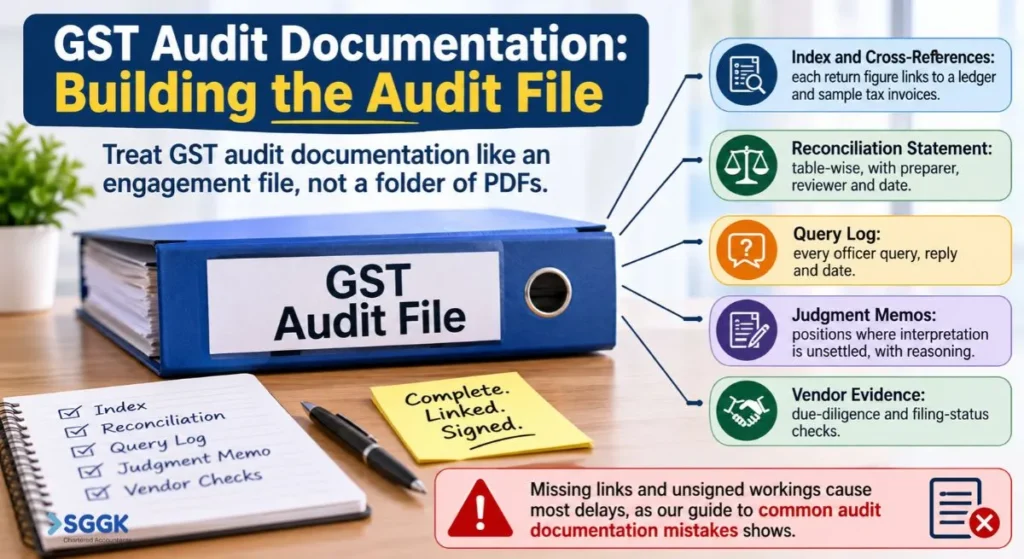
Treat GST audit documentation like an engagement file, not a folder of PDFs.
- Index and cross-references: each return figure links to a ledger and sample tax invoices.
- Reconciliation statement: table-wise, with preparer, reviewer and date.
- Query log: every officer query, reply and date.
- Judgment memos: positions where interpretation is unsettled, with reasoning.
- Vendor evidence: due-diligence and filing-status checks.
Missing links and unsigned workings cause most delays, as our guide to common audit documentation mistakes shows.
FY 2025-26 Is a Split-Rate Year: Where Reviewers May Look First
The two-tier structure of 5% and 18%, with 40% for demerit goods, took effect on 22 September 2025. FY 2025-26 therefore contains both rate regimes.
- Sample tax invoices on either side of 22 September 2025.
- Re-check HSN and SAC mapping for reclassified items.
- Test credit notes that cross the changeover date.
- Apply the existing Section 15(3)(b) conditions until Sections 153 to 155 of the Finance Act, 2026 are notified. The September 2026 review above reported them as pending.
Audit findings can be contested. A High Court held Rule 39(1)(a) ultra vires Section 20 and quashed an audit report built on it. Always check the legal basis of a finding.
Reading the GST Audit Manual from the US Side: A Note for CPA Firms
US sales tax has no input credit, so the supplier-dependent ITC chain is often the biggest conceptual gap for US engagement teams.
US concept | GST equivalent | Watch-out |
Sales tax return | GSTR-1 and GSTR-3B | Two returns that must agree |
Exemption certificate | Tax invoice, HSN or SAC, place of supply | Rate and place-of-supply errors |
Tax paid to vendor, no credit | ITC via GSTR-2B | Supplier default can cost credit |
PBC request | Notice in Form GST ADT-01 | 15 working days |
Tax provision tie-out | GSTR-9 vs financials | Reconciliation statement |
Teams that delegate fieldwork can see how offshore audit support is structured. Where the need is closer to the client, audit support services in Bangalore cover the same ground.
GST Audit Manual Snapshot: 2026 Data That Frames Preparation
Data point | Figure | Why it matters |
Audit notice period | At least 15 working days | Little time to assemble multi-year records |
Audit duration | 3 months, extendable by up to 6 | Plan resourcing for nine months |
GSTR-9 exempt turnover | Up to ₹2 crore (Notification 15/2025-CT) | Defines who files |
GSTR-9C threshold | Above ₹5 crore, self-certified | Reconciliation moved to the taxpayer |
GSTR-9/9C, FY 2025-26 | Due 31 December 2026; enabled on portal from 8 October 2026 per Taxscan | All GSTR-1 and GSTR-3B must be filed first |
Gross GST revenue, August 2026 | ₹1,99,853 crore (+14.8%) | Collections are growing |
Refunds, August 2026 | ₹31,795 crore (+67.9%) | Refund statements must tie to GSTR-2B |
Expected GSTAT inflow | Over 4.80 lakh cases | An appellate route now exists |
Our reading: growth in both collections and refunds points toward data-led scrutiny, which favours teams with clean, reconciled records.
Conclusion On GST Audit Manual
The GST Audit Manual rewards teams that prepare early. Fix links in the reconciliation chain, close ITC mismatch items before filing, and keep GST records indexed and signed off.
GST audit readiness is a team habit, not a one-time project. Whether the review is a departmental GST audit process under Section 65 or a voluntary GST compliance audit, the same indexed file and the same signed reconciliation statement answer most questions; teams that want a recurring review can look at internal audit support.
Engagement teams that would like a second view on how this applies to a specific client can speak with a qualified CA through SGGK’s partner team.
Prepare for a GST Audit with Confidence
Frequently Asked Questions About GST Audit Manual
What is the GST Audit Manual?
It is the Model All India GST Audit Manual 2023, a guide for tax officers on planning, conducting and closing audits. It is advisory and does not replace the Act or Rules.
Is a CA audit mandatory under GST now?
From FY 2020-21, the earlier CA audit was replaced by a self-certified GSTR-9C for turnover above ₹5 crore. Departmental audits under Section 65 and special audits under Section 66 remain.
What should a GST audit checklist include?
Sales and purchase tax invoices, GSTR-1, GSTR-3B, GSTR-2B and GSTR-9 data, ledgers, books of accounts, reconciliation workings and vendor evidence.
How long can a departmental GST audit last?
Three months from commencement, extendable by up to six months with the Commissioner’s recorded reasons.

Girish V
Fellow Chartered Accountant (FCA), Company Secretary Executive (CS Exe), Bachelor of Commerce (B.Com), and Partner with over 7 years of experience in Audit and Assurance at PwC. Has worked with clients across Information Technology, FMCG, Automobile, Industrial Automation, Renewable Energy, Startups, and Shared Services Centers. Known for strong analytical skills and a practical approach to identifying accounting, compliance, and ethical risks. As a Partner, focuses on management consultancy, audit support, advisory services, and financial reporting, helping clients strengthen governance and compliance frameworks. Areas of Expertise: GAAP (IGAAP & Ind AS), Audit & Assurance, Ind AS Accounting & Transition, Statutory Compliances, Management Consultancy Services, and Internal Control over Financial Reporting (ICFR).