
How a Management Audit Helps Indian Companies Improve Performance and Control Costs: Scope, Process and Checklist.
A management audit tests how effectively managers deliver on their objectives, whereas other audits focus on the accounts, the control environment or legal compliance. Management audit concentrates on non-monetary data including policies, structure, process, and decisions.
For growing companies in India, a management audit helps answer a simple question: where is the business losing time, money or control, and what should be fixed first?
Key takeaways
- A management audit reviews decisions and processes, not only the books.
- In India it is voluntary for most companies, but it connects to mandatory duties on internal audit, internal financial controls and risk reporting.
- Findings can inform budgeting, hiring, technology and cost control decisions.
- A statutory auditor is restricted by Section 144 from providing management services to the company it audits.
What Is a Management Audit and How Does It Differ From Other Audits?
A management audit evaluates how well management achieves its objectives, while other audits test accounts, controls or compliance. It mainly examines non-financial information such as policies, structures, workflows and decisions.
Audit type | Main question | Basis in India |
Management audit | Is management effective and efficient? | Voluntary, scoped by engagement |
Internal audit | Are controls and risks managed well? | Section 138, Companies Act, 2013 (specified companies) |
Statutory audit | Are the financial statements fairly presented? | Sections 139 to 143, Companies Act, 2013 |
Compliance audit | Are laws and policies followed? | Specific statutes or policies |
Is a Management Audit the Same as a Performance or Operational Audit?
These terms overlap because a performance audit compares outcomes with the goals set, while an operational audit reviews how well individual processes work day to day. A management audit instead reviews the choices management made to reach those outcomes.
Why Does a Management Audit Matter for Business Performance in 2026?
Governance expectations keep rising, so evidence about management effectiveness carries weight with boards, lenders and investors. The regulatory points below shape how Indian leadership teams are expected to run controls and records.
Regulatory data point | Why it matters to management |
Internal audit is mandatory for listed companies and larger unlisted ones under Section 138 and Rule 13 (source) | Leadership must show how controls and risks are reviewed |
Listed-company directors state the adequacy of internal financial controls (IFC) under Section 134(5)(e); every company’s board report covers IFC adequacy under Rule 8(5)(viii) (source) | Board reports address control adequacy |
The statutory auditor reports on IFC over financial reporting under Section 143(3)(i), unless exempt, as for certain private companies (source) | Control design is tested externally |
Accounting software must keep an edit log that cannot be disabled, for financial years commencing on or after 1 April 2023 (source) | Process discipline is visible to auditors |
Section 450 penalty for a missed internal auditor appointment: ₹10,000 plus ₹1,000 per continuing day after the first, capped at ₹2 lakh for a company and ₹50,000 for an officer (source) | Gaps carry a measurable cost |
Self-certified GSTR-9C applies above ₹5 crore turnover (source) | Reconciliation discipline matters more |
LLPs have no internal audit mandate under the LLP Act, 2008 (source) | A management audit can fill the assurance gap |
Regulatory watch: Corporate Laws (Amendment) Bill, 2026
The Bill, introduced in the Lok Sabha on 23 March 2026, would amend the Companies Act, 2013 and the LLP Act, 2008. PRS Legislative Research records a Joint Parliamentary Committee report on 3 August 2026 and lists proposals such as wider NFRA powers and higher small-company limits (PRS tracker). It does not list changes to the Section 138 thresholds, but confirm the current status before relying on any figure here.
What Does a Management Audit Evaluate in a Business?
A management audit usually covers six areas, each linked to a measurable improvement.
Area | What is reviewed |
Management practices and governance | Roles, reporting lines, decision rights and alignment between strategy and daily action |
Business process review | Order-to-cash, procure-to-pay and hire-to-retire cycles, duplicate approvals, rework, handoff delays and whether procedures match practice |
Resource utilisation | Use of people, capital, assets and software licences, idle capacity, avoidable overtime and spend not linked to a purpose |
Internal controls and risk | Segregation of duties, approval limits, risk-register ownership and ICFR alignment |
Cost control | Budget variances, vendor selection and renewals, and small recurring leakages |
Performance evaluation | KPI quality and ownership, realistic targets and timely management information |
Management Audit Process: Six Stages from Scoping to Closure
A well-run management audit process follows six stages, from scoping to follow-up.
Stage | Activity | Output |
1. Scoping | Agree objectives, functions and review period | Audit charter |
2. Information gathering | Collect policies, MIS, organisation charts and interview notes | Data request list |
3. Fieldwork | Walk through processes and test sample transactions | Working papers |
4. Analysis | Compare practice with policy, law and benchmarks | Gap register |
5. Reporting | Rate findings and recommend actions | Management audit report |
6. Follow-up | Track actions to closure | Action tracker |
Management audit services usually hand over a rated report, a gap register, a prioritised action roadmap with owners and timelines, and a tracker for closure.
What does a management audit report look like?
A report is easier to act on when every finding carries the same fields. This example is illustrative and does not describe any client.
Finding | Rating | Root cause | Recommendation | Owner |
Low-value purchases need four approvals | Medium | Delegation of authority not updated after growth | Revise approval limits by value band | CFO |
Three risks have no named owner | High | No Audit Committee review cadence | Assign owners; review quarterly | Company Secretary |
How long does it take?
The time needed varies with how wide the scope is, how many locations are covered and how quickly the records can be produced. Teams with strong audit readiness usually clear the information stage faster.
What Should a Management Audit Checklist Include?
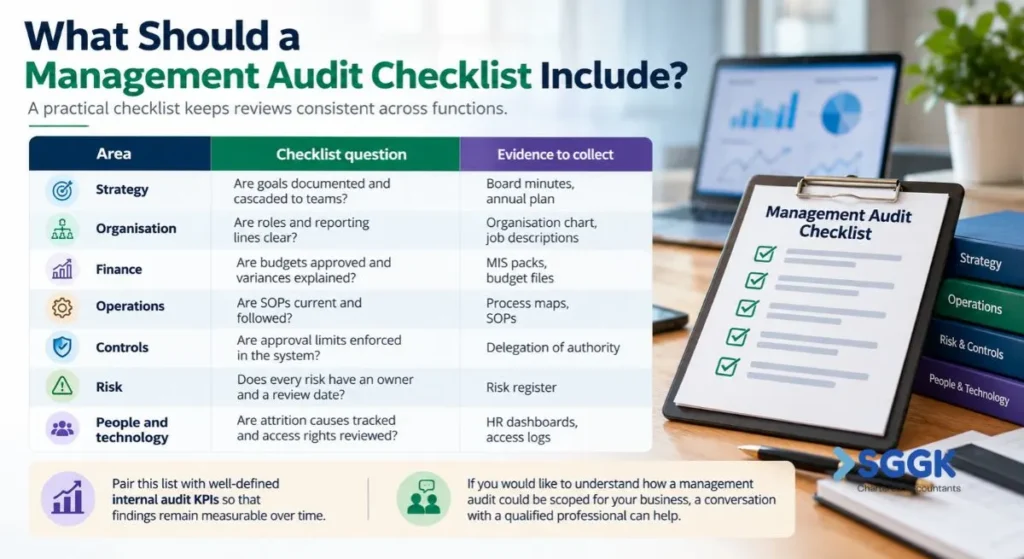
A practical checklist keeps reviews consistent across functions.
Area | Checklist question | Evidence to collect |
Strategy | Are goals documented and cascaded to teams? | Board minutes, annual plan |
Organisation | Are roles and reporting lines clear? | Organisation chart, job descriptions |
Finance | Are budgets approved and variances explained? | MIS packs, budget files |
Operations | Are SOPs current and followed? | Process maps, SOPs |
Controls | Are approval limits enforced in the system? | Delegation of authority |
Risk | Does every risk have an owner and a review date? | Risk register |
People and technology | Are attrition causes tracked and access rights reviewed? | HR dashboards, access logs |
Pair this list with well-defined internal audit KPIs so that findings remain measurable over time.
If you would like to understand how a management audit could be scoped for your business, a conversation with a qualified professional can help.
How Can Leaders Tell a Management Audit Is Due?
Five early signals suggest a management audit may add value.
Signal | What leaders notice | Likely root cause |
Decision delays | The same issue returns in every review meeting | Unclear decision rights |
Data conflicts | Departments quote different figures | Fragmented data sources |
Rework | Repeated queries and reconciliations | Weak documentation |
Growth strain | Headcount rises faster than output | Processes not scaled |
Late surprises | Exceptions are found after the period closes | Weak monitoring |
Practitioners commonly observe that efficiency leakage sits in handoffs between teams rather than inside a single department, which is why a management audit follows the process across functions.
What should CEOs and CFOs ask first?
- Which two processes consume the most management time each month?
- Where do approvals wait the longest, and why?
- Which risks have no named owner?
- Which KPIs changed a decision in the last quarter?
Where Does Your Business Stand on Management Maturity?
This illustrative SGGK framework helps leaders put the business in place before an audit begins. It is a discussion tool and not a formal standard.
Level | Description | Typical focus |
1. Reactive | Decisions are made case by case with little documentation | Build basic processes |
2. Defined | Policies exist but are followed unevenly | Improve consistency and ownership |
3. Managed | KPIs are tracked and risks have owners | Sharpen cost control |
4. Optimised | Decisions are data-led and reviewed regularly | Sustain gains and benchmark |
Is a Management Audit in India Mandatory or Voluntary?
The Companies Act, 2013 does not require a standalone management audit for companies in general, so most organisations commission one voluntarily.
Related duties are mandatory. Internal audit under Section 138 read with Rule 13 depends on company type and size, tested against the preceding financial year; check current MCA notifications. Section 138 has no penalty clause of its own, so the general penalty under Section 450 applies.
Company type | Internal audit becomes mandatory when |
Listed company | Always |
Unlisted public company | Paid-up capital ₹50 crore or more, turnover ₹200 crore or more, bank or financial-institution borrowings above ₹100 crore, or deposits of ₹25 crore or more |
Private company | Turnover ₹200 crore or more, or bank or financial-institution borrowings above ₹100 crore |
Who Should Conduct a Management Audit: Internal Team or External Experts?
Independence and expertise decide the choice, and many engagements combine both.
Factor | Internal team | External CA firm |
Independence | Moderate | Generally stronger where the firm has no other role in the company |
Process knowledge | High | Builds during engagement |
Benchmarking | Limited to own history | Can bring a cross-industry view |
Staff openness | Varies | Can differ; outside reviewers are sometimes seen as more neutral |
Can the statutory auditor also carry out the management audit?
Generally not for the same company. Section 144 of the Companies Act, 2013 bars an auditor appointed under the Act from providing certain services to the company, its holding company or its subsidiary. The list includes accounting and book keeping, internal audit, financial information system design, actuarial, investment advisory, investment banking, outsourced financial services and management services (Section 144). Whether an engagement counts as management services depends on its scope, so boards often assign the management audit to a separate firm and take professional advice.
Expert Insight From SGGK
“A management audit works best when leadership treats it as a mirror and not as a verdict. The most useful findings are rarely dramatic. They are small handoff delays, unclear approvals and unowned risks that quietly add up.”
CA Ravindranath G K, SGGK
What Are the Benefits of a Management Audit?
- Clarity for leadership: one consolidated view of strengths and weaknesses.
- Cost control: better resource utilisation and fewer hidden leakages.
- Stronger risk management: control gaps can surface before they grow.
- Improved external audits: good records can avoid repeat questions, an area discussed in our note on audit rework reduction.
- Stakeholder confidence: lenders and investors value documented governance
How Can You Prepare for a Management Audit?
Name one executive sponsor, share the latest organisation chart, SOPs and delegation of authority, keep recent MIS packs, budgets and risk registers ready, and agree how findings will be reported and who acts on them.
How Is Technology Changing the Management Audit?
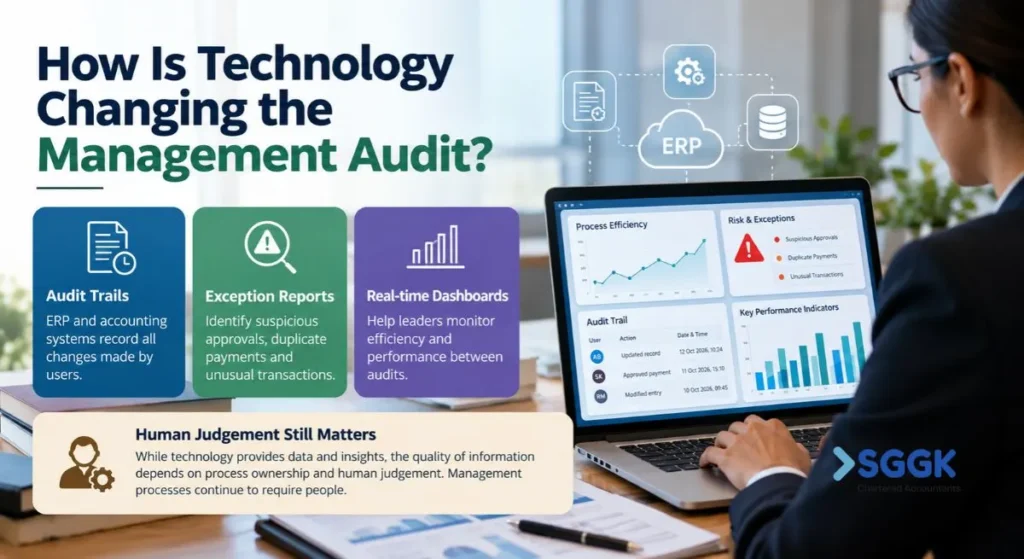
There are audit trails within ERP and accounting systems which record changes made by users, as well as exception reports for suspicious approvals and double payments. Dashboards allow leaders to monitor efficiency between audits, yet data quality is based on process ownership and judgement, and management processes is also left to humans.
What Mistakes Should You Avoid While Doing Audit?
Common errors include a vague scope with no executive sponsor, treating the review as fault-finding, poor data quality at the start, no follow-up after the report, and expecting an opinion on financial statements, which only a statutory audit provides. A lighter health check may suit very early-stage companies with few formal processes.
Conclusion
A management audit gives leadership an evidence-based view of operational efficiency, controls and cost. Reviewing management practices at planned intervals supports clearer, better-documented decisions.
Leaders who want to understand how a management audit could be scoped for their business may consider a conversation with a qualified professional. SGGK’s audit support services in Bangalore shares educational guidance on this topic.
Understand Your Management Audit Requirements
Frequently Asked Questions About Management Audit
What is a management audit in simple words?
It is a structured review of how management runs the business. It looks at decisions, processes, controls and the use of people, money and assets, then reports gaps with practical recommendations, without giving an opinion on the accounts.
Who needs a management audit?
Growing companies, family-owned businesses preparing for scale and boards planning restructuring often benefit most. Lenders and investors may also ask for an independent view of governance. Very early-stage companies may start with a lighter health check.
How is it different from an internal or operational audit?
An internal audit tests whether controls operate as designed and is mandatory for specified companies under Section 138. An operational audit examines specific operations. A management audit asks whether the design, decisions and resource use are right in the first place, and is voluntary.
Is a management audit mandatory in India?
No standalone management audit is required for companies generally. Related duties are mandatory, including internal audit for specified companies, reporting on internal financial controls and maintaining an audit trail in accounting software.
How often should it be done?
Frequency depends on size, risk and pace of change. Many businesses review key functions every few years, or earlier when strategy, leadership or scale changes sharply.
Can a management audit help with cost control?
It may emphasize spending habits, duplication of effort, poor vendor management, and slow approval processes that result in increased costs. The amount of savings will depend on the company's response to the suggestions; hence the importance of ownership and timeframes.

CA.Sandeep Chandrashekar
Fellow Chartered Accountant (FCA), Bachelor of Commerce (B.Com), and Partner with 10+ years of experience in audit, taxation, and compliance. Previously associated with PwC (Lovelock & Lewes) for six years and in practice since 2017. Has led engagements across Manufacturing, Retail, IT, Hospitality, and Education sectors and currently heads the firm's Compliance, Offshore Audit Support, and KPO divisions. Areas of Expertise: Internal Audits, Direct & Indirect Taxation, Due Diligence, and Statutory Compliance.