
What Is a PBC List for Audit? Meaning, Documents & Preparation Checklist
You get an email from your auditor two weeks before fieldwork starts. Attached is a spreadsheet titled “PBC List FY2025-26.”
Forty rows. Bank statements, board minutes, fixed asset registers, related party confirmations, and a deadline three days out.
If you have never seen one before, the first reaction is usually panic, not preparation.
A PBC list for audit, short for Prepared By Client list, is simply the auditor’s document request list. It tells your finance team exactly what to gather, in what format, and by when. Understanding it early is what separates a smooth audit from a chaotic one.
This guide breaks down the meaning of the PBC list, what documents go into it, how the format works for Indian statutory audits, and a practical checklist you can use before your next audit cycle begins.
What Is a PBC List for Audit?
PBC stands for Prepared By Client. In plain terms, it’s every schedule, reconciliation, and supporting record your finance team needs to hand over so the audit team can actually form an opinion on the financial statements. Without it, the auditor has nothing to test.
This isn’t just a formality either. Under SA 500 on audit evidence, one of the Indian Standards on Auditing, auditors are required to gather sufficient and appropriate evidence before they can sign off on an opinion. They can’t just take management’s word for it. Since the auditor cannot create this evidence themselves, the responsibility falls on the client’s finance team to prepare it. That is the entire logic behind the PBC list. It exists because the law separates two roles clearly. Management prepares the financial statements and the records behind them. The auditor examines that evidence independently.
For a company registered under the Companies Act, 2013, this separation is not optional. Section 143 requires the auditor to report on whether the financial statements give a true and fair view, and that opinion has to rest on evidence, not assumption.
You may also see this called a “PBC request list” or “PBC schedule” in some firms. It is the same document, just a different name for it.
Why Do Auditors Issue a PBC List?
Ask any audit partner why the list matters, and the answer is almost always the same. Without it, fieldwork turns into a scavenger hunt.
A PBC list exists to:
- Set clear expectations on what is needed and by when
- Reduce back-and-forth emails during fieldwork
- Give the finance team enough lead time to pull records from multiple departments
- Create a single audit evidence request that both sides can track
- Help the auditor plan resource allocation for fieldwork days
A well-prepared PBC checklist for statutory audit purposes is sent 30 to 45 days before fieldwork in most Indian engagements. That window matters. Items like bank confirmations, legal confirmations from external counsel, and third-party balance confirmations take time because they depend on someone outside your organisation responding.
What Documents Are Usually Part of a Prepared By Client List For an Audit?
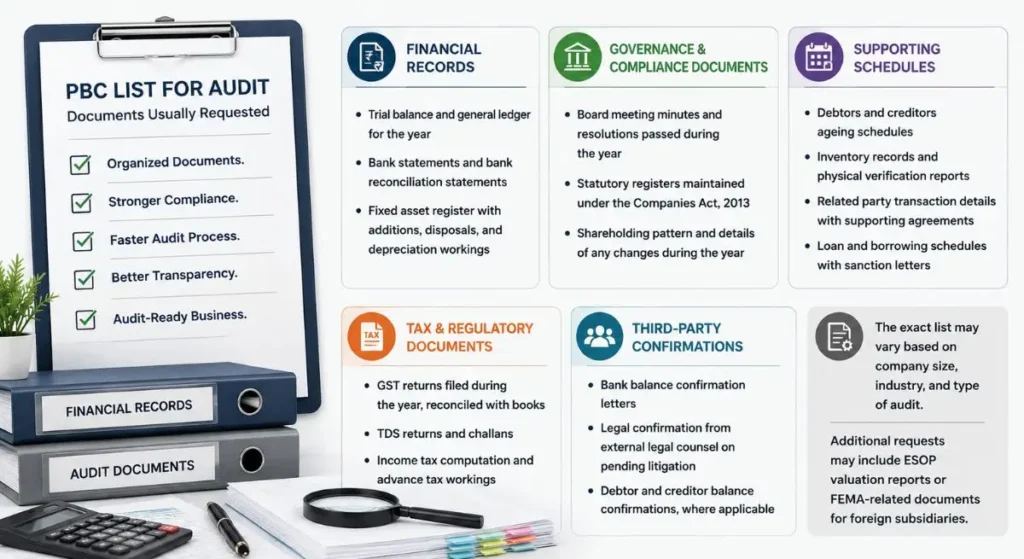
The exact PBC list for an audit changes depending on company size, industry, and whether it is a statutory audit, tax audit, or a special-purpose audit for investors. That said, most Indian statutory audits ask for a fairly consistent core set.
Financial records
- Trial balance and general ledger for the year
- Bank statements and bank reconciliation statements for all accounts
- Fixed asset register with additions, disposals, and depreciation workings
Governance and compliance documents
- Board meeting minutes and resolutions passed during the year
- Statutory registers maintained under the Companies Act, 2013
- Shareholding pattern and details of any changes during the year
Supporting schedules
- Debtors and creditors ageing schedules
- Inventory records and physical verification reports
- Related party transaction details with supporting agreements
- Loan and borrowing schedules with sanction letters
Tax and regulatory documents
- GST returns filed during the year, reconciled with books
- TDS returns and challans
- Income tax computation and advance tax workings
Third-party confirmations
- Bank balance confirmation letters
- Legal confirmation from the company’s external legal counsel on pending litigation
- Debtor and creditor balance confirmations, where applicable
This is not an exhaustive list. Startups with ESOP schemes will see additional requests around valuation reports. Companies with foreign subsidiaries will see FEMA-related documentation added in. The scope always maps back to what is on your balance sheet and what changed during the year.
Is a PBC List the Same as an Auditor's Document Request?
Not quite, and the distinction matters for how you plan your audit fieldwork preparation.
A PBC list is the formal, upfront request sent before fieldwork starts. It covers the known, recurring set of supporting schedules an auditor needs every year for a company of that size and industry.
An auditor document request, on the other hand, can come up at any point during fieldwork. If the audit team spots something in your revenue recognition policy or notices a gap in your related party transaction trail, they will raise a fresh query on the spot.
Think of the PBC list as the planned request and the in-fieldwork queries as the reactive layer built on top of it. Both count as audit evidence request items, and both get logged the same way, but only one arrives with weeks of lead time.
This is also why finance teams that treat the PBC list as the only document they will ever need to submit tend to get caught off guard mid-audit. Building in slack for follow-up queries, rather than assuming the original list is final, is part of realistic audit readiness.
What Does a PBC List Format India Auditors Use Look Like?
There is no single mandated PBC list format India-wide, but most audit firms structure it the same practical way. A usable format has five columns.
Column | Purpose |
Item description | What exactly is being requested |
Owner | Which team member is responsible for providing it |
Due date | When it needs to reach the audit team |
Status | Not started, in progress, submitted, or under review |
Auditor remarks | Space for queries or follow-up requests |
Some firms share this as a static Excel file circulated by email. Others use a shared drive or an audit management portal where both sides can update status in real time. For finance teams handling their first audit, a shared tracker works far better than an email thread that gets buried after the third round of attachments.
How Do You Prepare for a Statutory Audit Using a PBC Checklist?
Preparation is less about working harder during audit week and more about starting earlier. Here is a practical audit readiness checklist finance teams can follow once the PBC list arrives.
Four to six weeks before fieldwork
- Read the full list line by line and flag anything unclear to the auditor immediately
- Assign an owner to every single item, not just the departments
- Identify which items depend on external parties, such as banks or legal counsel, and initiate those requests first
Two to three weeks before fieldwork
- Complete all bank reconciliations and close open items
- Finalise the fixed asset register and reconcile it with the general ledger
- Pull related party transaction details and match them against board-approved agreements
One week before fieldwork
- Do a mock review of every submitted document against the original request
- Check that file names and folder structures match how the auditor asked for them
- Confirm that all third-party confirmations sent out have actually been received back
During fieldwork
- Keep one point of contact for auditor queries instead of routing questions across the team
- Log every additional document request as it comes in, since PBC lists often grow once fieldwork starts
- Respond to queries within 24 to 48 hours to avoid delaying the audit timeline
Following this sequence turns a two-week scramble into a controlled process, and it is usually the single biggest factor behind audits that close on time versus audits that drag on for months.
What Documents Are Required for Audit if the PBC List Feels Incomplete?
Sometimes the PBC list your auditor sends looks shorter than expected, especially in a first-year audit or when moving from one audit firm to another. This does not mean fewer documents are required. It usually means the list will expand once the audit team starts fieldwork and identifies specific risk areas.
A good practice is to prepare beyond the written list for high-risk areas such as revenue recognition, related party transactions, and any accounting estimate involving judgement, like provisions or asset valuations. Auditors almost always ask deeper questions in these areas regardless of what the original PBC list stated.
What Mistakes Do Finance Teams Make With PBC Lists?
After supporting statutory audits for funded startups, SMEs, and larger companies across Bangalore and other cities, a few patterns show up repeatedly.
- Treating the PBC list as one department’s job instead of assigning owners across finance, legal, and HR
- Sending documents in inconsistent formats, which slows down the audit team’s review
- Waiting until the deadline to start on items that depend on third parties
- Submitting documents without checking whether they tie back to the trial balance
- Not tracking status, which leads to duplicate follow-up emails from both sides
None of these are complicated fixes. They come down to starting early and keeping one shared tracker instead of scattered email chains.
Where Is PBC List Management Headed in Indian Audits?
The static Excel-based PBC list is on its way out for any company that raises institutional capital.
PE and VC-backed clients are already moving this way. Investors expect audit-ready books all year round, not a scramble every March. That is pushing PBC preparation from an annual fire drill into a monthly discipline, where reconciliations and related party documentation stay current instead of being reconstructed at year-end.
Format is shifting too. Shared trackers and audit portals are replacing email-and-Excel threads, mainly because version control on a single spreadsheet edited by ten people rarely holds up. Our view: any company past the seed stage should treat its PBC process as a live, shared workflow, not a spreadsheet exercise.
Scope is also growing. As disclosure expectations around related party transactions and ESOP valuations tighten, PBC lists for funded startups are getting longer, not shorter, year over year. Assuming next year’s list will match last year’s is usually where teams get caught off guard.
How Do You Get PBC Preparation Right Without the Internal Scramble?
A PBC list is not paperwork for its own sake. It is the backbone of how audit evidence gets organised, and how quickly your audit closes depends heavily on how well it is managed on the client side.
At SGGK, Internal audit support services work with finance teams across Bangalore and pan-India, including funded startups, PE and VC-backed companies, and first-time audit clients, to manage the PBC process end-to-end so internal teams are not left chasing documents during fieldwork. If your team is preparing for an upcoming statutory audit and wants a second set of eyes on your PBC readiness, reaching out to a firm that handles this regularly can save weeks of back and forth.
Get Your PBC List Audit-Ready
Frequently Asked Questions About PBC List for Audit
Who prepares the PBC list, the client or the auditor?
The auditor prepares and sends the PBC list. The client's finance team is responsible for gathering and submitting everything on it.
When should a company expect to receive its PBC list?
Most Indian statutory audits send the PBC list 30 to 45 days before fieldwork begins, giving the finance team time to prepare records and chase third-party confirmations.
Does a PBC list change during the audit?
Yes, quite often. Once fieldwork starts, auditors frequently come back with follow-up requests, especially around related party transactions or anything involving accounting estimates. So don't treat the original list as the final word.
Is a PBC checklist the same for every audit?
Not really. It shifts depending on your company's size, industry, and the type of audit being done. A tax audit list won't look like a statutory audit list, and if you're a startup with ESOPs, expect a few extra valuation-related documents thrown in too.