How Does Offshore Audit Support For CPA Firms Help Handle Multiple Engagements at Once?
If your firm has ever had three engagement teams asking for the same senior at the same time in March, this article is for you.
Offshore audit support for CPA firms lets you run multiple engagements concurrently without adding permanent headcount. Trained audit professionals in India handle workpaper preparation, reconciliations, PBC tracking, and testing support, under the supervision of the engagement’s US-based partners and managers. It works within existing AICPA quality control and supervision requirements. It has moved from a niche cost-cutting tactic to a mainstream capacity strategy used by firms of every size.
This piece covers:
- What offshore audit support actually includes
- Why concurrent engagements have become harder to staff
- What the current data shows about the staffing gap
- How firms structure the arrangement so quality and independence stay intact
Key takeaways
- The audit opinion, risk assessment, and engagement quality review always stay with the licensed US CPA firm. Offshore support only covers defined, procedural work performed under supervision.
- Staffing pressure is measurable, not anecdotal: CPA Exam candidates, licensed staff at large firms, and time-to-fill for audit roles have all moved in the wrong direction since 2020.
- Firms that succeed with offshore support usually pilot it on one engagement type or service line first, then build it into the year-round workflow rather than treating it as a one-off busy-season fix.
What Is Offshore Audit Support for CPA Firms?
Offshore audit support is an arrangement where a CPA firm delegates defined, procedural pieces of the audit file to a team based outside the US, typically in India. The firm retains full responsibility for planning, risk assessment, review, and the final opinion. The offshore team works inside the firm’s own audit methodology and software, under instructions set by the engagement partner and manager.
This is not the same as outsourcing the audit itself. Under AICPA auditing standards (the AU-C sections that govern non-issuer audits) and, where applicable, PCAOB standards for issuer audits, the signing CPA firm remains fully responsible for the sufficiency of audit evidence, the conclusions reached, and the opinion issued. Offshore audit support sits underneath that responsibility, not alongside it.
Tasks typically delegated:
Task | What it involves |
Workpaper preparation | Formatting workpapers to firm templates |
Reconciliations | Trial balance tie-outs and reconciliations |
PBC management | List creation, tracking, and client follow-up drafting |
Testing support | Vouching, sampling, and analytical procedures under a defined program |
Review readiness | Documentation cleanup ahead of partner and EQR (engagement quality review) sign-off |
Why Handling Multiple Engagements at Once Has Gotten Harder?
Running concurrent engagements has always required careful scheduling. What has changed over the past few years is the pool of qualified staff available to schedule against. Three separate pressures are converging on CPA firms at the same time.
The CPA pipeline has shrunk
- New CPA Exam candidates fell from 42,626 in 2023 to 28,082 in 2024.
- The AICPA partly attributes the drop to a rush of candidates testing before a 2024 exam format change, though it follows a longer downward trend in accounting graduates.
- Bachelor’s and master’s degrees in accounting fell 6.6% in the 2023-2024 academic year, continuing several years of decline, even as accounting program enrollment has started to recover.
What this means: Fewer new entrants are reaching the profession each year, so firms cannot rely on hiring their way out of a capacity gap during busy season.
Experienced staff are leaving faster than they are being replaced
- Roughly 300,000 accounting professionals have left the workforce since 2019, by industry estimates.
- At large firms, the share of staff holding an active CPA license fell from around 56% in 2020 to about 48% overall, and to roughly 41.5% at the largest firms by 2024 (Inside Public Accounting data).
What this means: Fewer licensed reviewers are available per engagement even before busy season scheduling begins, which pushes more review work onto the same few people.
Open audit and tax roles are taking longer to fill
- Roughly half of industry leaders report that filling an audit or tax specialist role now takes 60 days or more.
What this means: For a firm staffing a January-to-April engagement calendar, a two-month hiring cycle that starts in December is already too late.
The combined effect: the same handful of seniors and managers get pulled across four or five client engagements simultaneously. This is exactly the condition offshore audit support is built to relieve.
Capacity Strain and Audit Quality: What the Data Shows
A reasonable question is whether a stretched-thin team actually shows up in audit quality data, or whether this is just a staffing inconvenience. PCAOB inspection data offers a useful, if imperfect, lens.
PCAOB overall audit deficiency rate:
Year | Deficiency rate |
2020 | 29% |
2021 | 34% |
2022 | 40% |
2023 | 46% |
2024 | 39% |
Source: PCAOB inspection figures reported through the SEC’s review of the inspection program.
That three-year climb runs alongside the years the AICPA’s own data shows the sharpest contraction in new CPA candidates and the steepest rise in staff departures.
This is a correlation worth noting rather than a proven cause. Inspection scope, staff experience, and PCAOB methodology also changed over the same period, and the PCAOB itself has flagged debate over how “deficiency” is defined. Still, it lines up with a pattern several audit quality researchers have pointed to: capacity-constrained teams are more likely to leave gaps in fraud risk documentation, audit committee communication, and evidence for complex estimates. These are three of the categories PCAOB inspectors flag most often.
On the preparer side, corporate disclosure data tells a related story:
- Between July 2023 and June 2024, close to 640 US-listed companies disclosed internal control material weaknesses tied to accounting talent gaps.
- The share of companies flagging staffing-related control issues went from about 30% in 2022 to 34.4% in 2024.
What this means: when a client’s finance team is short-staffed, the audit team feels it too. PBC responses come in late. Rework goes up.
Key 2026 staffing and outsourcing data at a glance
Metric | Data point | Source |
New CPA Exam candidates | 42,626 (2023) down to 28,082 (2024); 16,448 in first half of 2025 | AICPA 2025 Trends Report |
Accounting degrees awarded (bachelor’s + master’s) | 55,152 in 2023-24, down 6.6% year over year | |
Accounting professionals who left the workforce | Approximately 300,000 since 2019 | AICPA/BLS data, cited across industry analyses |
CPA-licensed staff at large firms | Down to roughly 41.5% of staff in 2024 | Inside Public Accounting, via Atlas CPA Index |
Time to fill audit/tax specialist roles | Around 50% of firms report 60+ days | 2026 industry hiring surveys |
CPA firms outsourcing some accounting or bookkeeping work | Approximately 25% | AICPA data |
PCAOB overall audit deficiency rate | 29% (2020) to 46% (2023), easing to 39% (2024) | PCAOB inspection data |
US-listed companies disclosing staffing-linked control weaknesses | Share rose from 30% (2022) to 34.4% (2024) | SEC filings analysis |
How Offshore Audit Support For CPA Firms Solves the Concurrent-Engagement Problem?
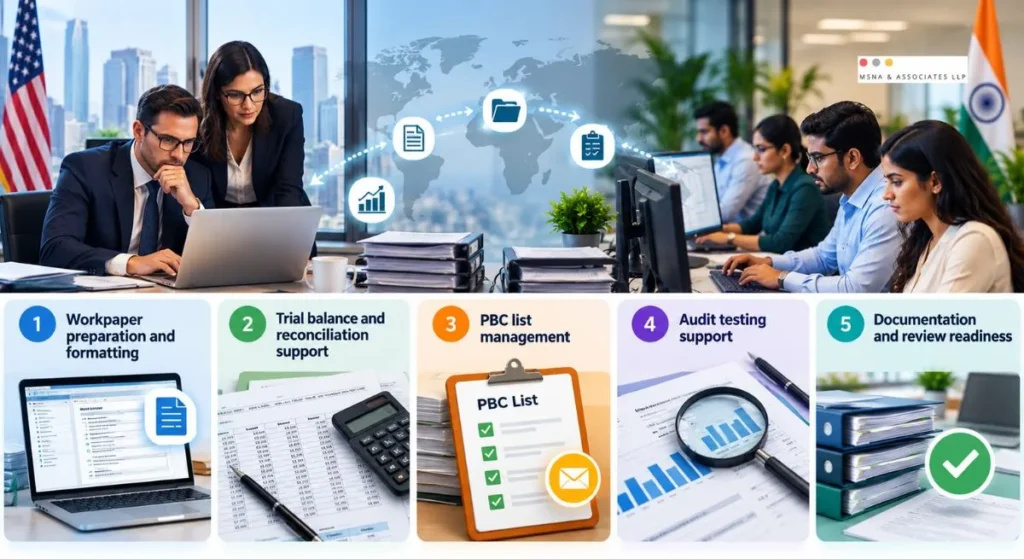
The core mechanism: procedural, evidence-gathering work moves to a dedicated offshore team. This frees the US-based partner and manager to focus on judgment-heavy work across more than one engagement at a time.
1. Workpaper preparation and formatting
Offshore teams build workpapers directly inside the firm’s audit software, following the firm’s templates, tick-mark conventions, and cross-referencing standards. This is repetitive, standards-based work where quality depends on consistency rather than judgment, which makes it well suited to a trained offshore team working from a documented methodology.
2. Trial balance and reconciliation support
Tying out trial balances, reconciling subledgers to the general ledger, and preparing lead schedules are time-intensive but rule-based tasks. Offshoring this layer typically clears the biggest single bottleneck in the first two weeks of fieldwork.
3. PBC list management
Coordinating PBC requests, tracking what has and has not been received, and drafting follow-up communications for partner review keeps engagements moving without pulling a senior off testing to chase documents.
4. Audit testing support
Under a testing program the engagement team defines, offshore staff perform vouching, sampling, and analytical procedures, documenting exceptions for the US team to evaluate and resolve. The judgment call on what an exception means for the opinion stays with the licensed reviewer.
5. Documentation and review readiness
Before a file goes to the partner or the engagement quality reviewer, offshore support can clean up cross-references, close open review notes, and confirm the file matches the firm’s documentation checklist. This shortens the review cycle itself.
What This Looks Like During Busy Season ?
Picture a mid-sized CPA firm running four concurrent statutory and non-profit audits from mid-January through March.
Under a traditional staffing model:
One senior rotates across all four engagements, working evenings to keep each file moving.
With offshore audit support in place:
- The offshore team works US business hours on India’s clock overlap, typically producing a full day of progress by the time the US team logs on.
- Workpapers get prepared and PBC items get cleared overnight relative to the US day.
- The US senior reviews completed sections each morning and resolves exceptions.
- The freed-up time goes to risk areas that need professional judgment: estimates, going concern, related party transactions, and client communication.
The result: the same senior can realistically support two or three engagements at the intensity that used to require full-time attention on one.
Quality Controls and Data Security in an Offshore Arrangement
Two objections come up in almost every conversation about offshore audit support. Both are answerable with the right controls in place.
Quality variance is managed through:
- A documented methodology and standardized templates
- A review checklist before any file moves back to the US team
- A fixed point of contact on the offshore side who understands the client and engagement history, rather than rotating staff in and out
Data security is managed through:
- SOC 2-aligned infrastructure
- Data access restricted by engagement
- Encrypted client portals rather than email attachments
- Confidentiality and data protection agreements that mirror the firm’s own client confidentiality obligations under the AICPA Code of Professional Conduct
Firms new to offshore support generally do well to start with a defined pilot, often one engagement type or a single service line such as reconciliations, before expanding scope. Measured results from a pilot period make the case for expansion more convincingly than a broad rollout without a track record.
Common Mistakes CPA Firms Make When Adding Offshore Audit Support
Mistake | Why it matters |
Delegating judgment, not just procedure | Risk assessment, materiality decisions, and the final opinion should stay with the US engagement team. Offshore support works best on defined, procedural tasks. |
Skipping the pilot phase | Moving an entire engagement portfolio offshore in one busy season, without first testing the workflow on a smaller scope, makes it hard to isolate what is and isn’t working. |
Treating it as a one-time busy-season fix | Firms that get the most value typically build offshore support into their standing engagement workflow year-round, not just as a March surge valve. |
Underinvesting in the handoff process | Clear instructions, a shared file structure, and a defined review checklist matter more to quality than the offshore team’s experience level alone. |
When Offshore Audit Support For CPA Firms Doesn't Apply?
Offshore audit support for CPA firms is not a substitute for the professional judgment, independence, and supervision requirements that govern who can perform and sign off on an audit.
Responsibilities that stay with the licensed CPA firm and its US-based partners, under AICPA and, where relevant, PCAOB standards:
- Risk assessment
- Evaluating fraud risk
- Forming the audit opinion
- Engagement quality review
Firms considering the arrangement should also confirm their engagement letters and any client-specific confidentiality terms permit the use of a third-party service provider, and disclose that use where their professional standards or client agreements require it.
Getting Started With Offshore Audit Support For CPA Firms
Firms typically begin by mapping which parts of a current audit file are procedural versus judgment-based, then piloting offshore support on one engagement type before scaling across the busy season calendar. Consulting with an audit support partner experienced in US audit standards can help a firm assess where the capacity gap actually sits before committing to a broader arrangement.
SGGK works with CPA firms to scope and pilot offshore audit support on defined engagement types. If your firm is evaluating this for the next busy season, our team can walk through where the capacity gap sits.
Explore Offshore Audit Support for CPA Firms
Frequently Asked Questions About Offshore Audit Support For CPA Firms
Is offshore audit support allowed under AICPA and PCAOB standards?
Yes, provided the CPA firm retains responsibility for planning, supervision, review, and the final opinion. The offshore team performs defined procedures under the direction of the engagement partner and manager. It does not replace the firm's own judgment or sign-off responsibilities.
Can an offshore team sign the audit opinion?
No. Only the licensed CPA firm responsible for the engagement can issue the opinion. Offshore teams stick to procedural and documentation work, and they do it under supervision.
What audit tasks are commonly delegated offshore?
Workpaper preparation, trial balance reconciliations, PBC list tracking, testing support such as vouching and sampling under a defined program, and documentation cleanup ahead of review.
How is client data kept secure with an offshore team?
Through SOC 2-aligned infrastructure, encrypted client portals, engagement-level access controls, and confidentiality agreements consistent with the AICPA Code of Professional Conduct.
Does using offshore audit support need to be disclosed to clients?
Firms should check their engagement letters and any client-specific terms, since disclosure requirements vary by client agreement and by state board rules. Many firms address this proactively in their standard engagement letter language.