Internal Audit Checklist: How Finance Teams Can Prepare Before the Auditor Arrives?
In many organizations, finance departments often think that they have prepared an audit until they are asked for important paperwork, such as valid documents, reconciliations, and supporting audit evidence.
But many audit-related delays do not only involve accounting problems. It also involves a lack of proper documentation and a year-end rush in assembling the documents.
Organize all documents required by the auditor, complete all account reconciliations, review all transactions recorded in the general ledger against the supporting documents, and create all supporting schedules the auditor expects.
When organizations identify these actions up front, they will reduce the likelihood of audit-related disruptions, improve auditor efficiency, and demonstrate stronger control over their internal processes.
According to Business Wire, 73% of auditors spend 50% or more of their time on manual, spreadsheet-based processes. 50% name reconciliation as the most challenging aspect of their job or their greatest audit headache.
At SGGK, we use a checklist for internal audits and statutory audits to help finance teams across multiple industries with both statutory and internal audits.
One thing we have always noticed is that complicated accounting processes do not cause audit delays. They are caused by disorganized documents, incomplete reconciliations, or a lack of clear ownership on who is responsible for responding to audit requests.
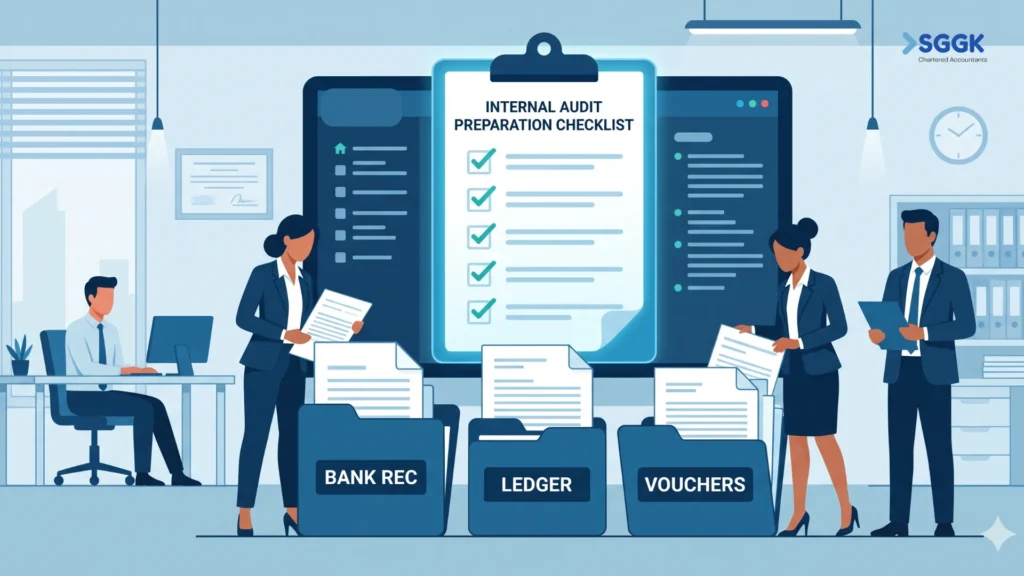
Why Audit Preparation Matters More Than Most Finance Teams Realize?
The Hidden Cost of Not Being Prepared for an Audit
An unprepared company requires significant time, money, and resources. There are complications associated with inadequate preparation for an audit:
- What should take two weeks may take an additional five or more weeks to complete.
- Auditors will continue to ask questions about the same transaction because all the required documents cannot be provided.
- Delays in the issuance of financial reports.
- Management spends considerable time answering questions about audit procedures.
- Fees related to the audit engagement increase as the auditor will spend additional time on this engagement.
Lack of an internal audit preparation checklist results in increased costs, additional stress on the finance department, and delays in the audit process.
The EY Global Audit Survey indicates companies with organized documentation and frequent process monitoring build greater stakeholder trust and have fewer recurring audit issues over time.
The Institute of Internal Auditors (IIA) also states that when documentation is kept up to date and strong internal controls are in place, a 12-month period should yield more successful audits.
Just think about this?
Will your team have ready access to all the required documents, or would you prefer to provide them to the auditors within one hour?
Audit Readiness Is a Governance Function, Not an Annual Exercise
At SGGK, we keep the audit file structure up to date throughout the financial year. Through our Audit Support Services, we help clients complete and approve monthly reconciliations no later than the 10th day of the following month, update the necessary schedules as of the end of the quarter, and file documentation supporting all transactions.
As a result, audits are completed in less time, auditors have fewer questions to ask during the audit, and overall results are better. We refer to this proactive approach to preparing for an audit as the Prepare-versus-React methodology for managing financial governance.
Documentation Checklist for Internal Audit
A common issue with an audit is that the required documents are spread across multiple e-mail accounts, computer files, and many different company personnel.
The solution to making the audit stress-free is to have the required documents needed for the internal audit ready before the commencement.
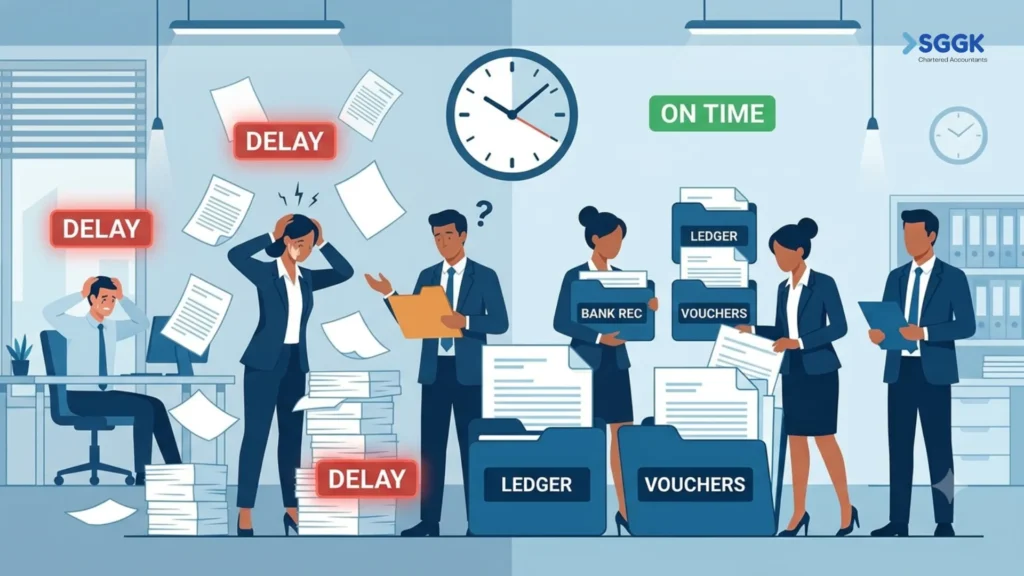
Corporate Documents & Company Documents
The following items should be kept in hand for audit reference:
- Company & Director PAN.
- GST Registration & Amendments.
- Certificate of Incorporation & CIN.
- Memorandum of Association.
- Articles of Association.
- Board Resolutions for Accounting Period.
- Shareholder Agreement.
- Investment and Customer Contract.
- Loan Agreement between Banks or NBFC & Other Parties
- Business Licenses.
Financial Documentation
Auditors request financial records, which they review before starting their audit:
- A trial balance is the financial statement generated at the end of the audit period.
- General Ledger.
- Audited Financial Statements of the current year and the previous year.
- Notes to Accounts and Supporting Schedules.
- Management Reports.
- MIS Reports.
- Previous Year’s Audit Report and Management Letter.
Compliance Records
Auditors will review compliance records before beginning their audit:
- File TDS Returns (Form 24Q and Form 26Q) and TDS Challans
- File GST Returns (Form GSTR-1, GSTR-3B, GSTR-9)
- File Provident Fund and Employee State Insurance Returns
- File Annual Return with the Registrar of Companies (Form AOC-4, MGT-7, ADT-1)
- File Income Tax Returns.
- File FEMA and Reserve Bank of India Compliance Documents.
Keeping all audit-related documents in a single, organized location with appropriate file names and version control will save time and help in the efficient completion of your audit.
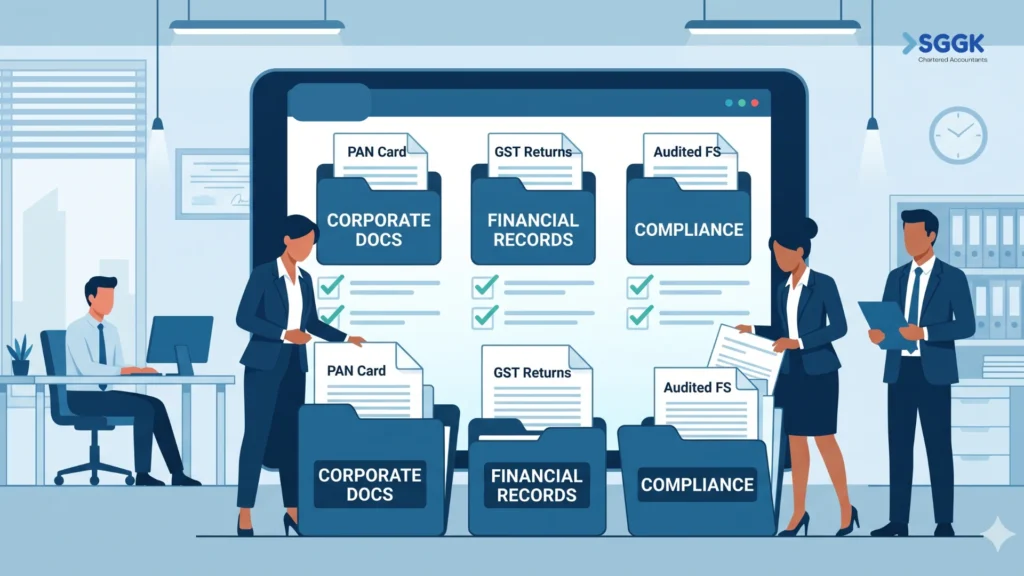
Reconciliation Checklist Every Finance Team Should Complete
Incomplete bank reconciliation is one of the most common causes of audit delays.
Most of the time, the reconciliation has not been completed correctly, or because the checklist of internal audits has not been reviewed.
For all bank accounts owned by your business, you must do the following:
- Obtain a monthly bank statement covering the entire period the auditor is examining.
- Review and explain any outstanding cheques that have not cleared your bank account in 90 days.
- Investigate and properly post any funds deposited into your account that cannot be identified.
- Do a thorough review of the bank account at the end of every month to ensure there are no discrepancies. This includes all non-local currency transactions using their daily equivalent exchange rates as needed.
Conducting routine monthly bank reconciliations would have prevented this issue from occurring in the first place.
Accounts Receivable Reconciliation
- Produce a customer outstanding balance report for all customers and review it.
- Send balance confirmations to major customers and prepare confirmation letters.
- Identify discrepancies in customer balances in accordance with the provisions.
- Verify documentation for all write-offs that document the authorizations.
- Verify that customers’ advances were received in the correct amounts for the shipments they actually received.
Accounts Payable Audit
- Be prepared to conduct an Accounts Payable audit by obtaining vendor statements and reconciling them against your company’s records.
- Make sure any goods received can be matched against any unpaid vendors that you may have.
- Review all debit notes issued to vendors, research them, and reconcile them against the vendors’ records.
- Obtain a detailed list of vendor advances and identify any that have been on the list for an extended period.
- Document all disputes with the vendor.
GST Reconciliation
GST reconciliation is a very important part of internal audit documentation and often an issue, as it takes too much time during a GST audit.
- You need to download GSTR-2B for each month and compare it against your purchase records.
- Reconcile the amount of Input Tax Credit available (ITC) versus the amount of ITC you actually claimed.
- You need to compare your accounting records to GST returns for the year.
- Check for all the errors, identify, explain, and correct them, and verify all transactions and entries.
This version provides additional clarity to owners and non-accounting staff while still complying with audit requirements.
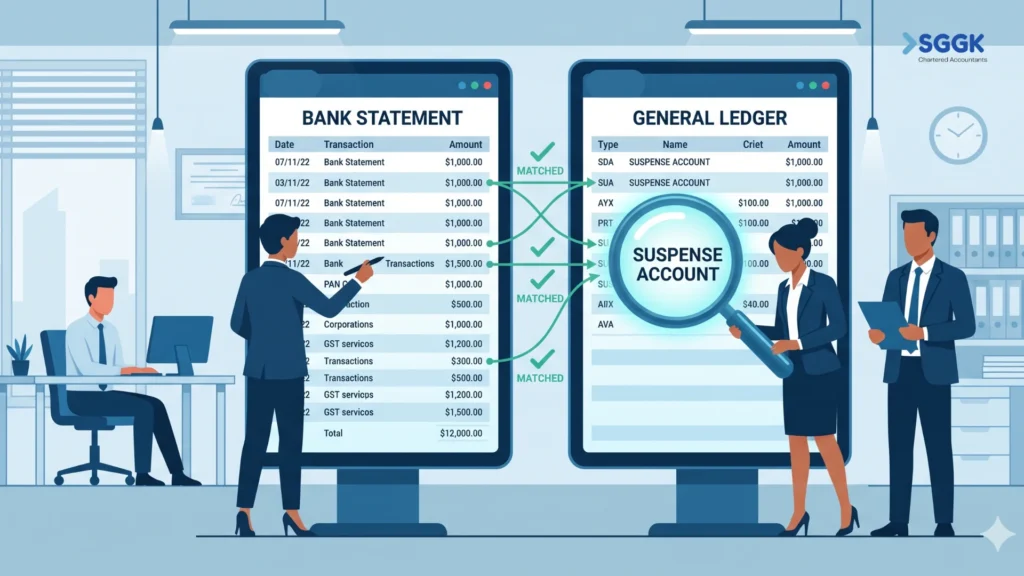
Ledger Clean-Up Before the Audit Begins
Keep Your General Ledger Clean & Organized
Your auditors will have a much easier time understanding your accounts if your general ledger is clean and organized. A cluttered general ledger will create unnecessary problems for your auditors, slowing the entire audit trail.
Review Your Suspense Accounts
Suspense accounts should not have any balance until the audit begins.
Before beginning the audit:
- You can review each entry in your suspense account.
- Determine the reason for the entry.
- Move it to the appropriate account.
Do you have sufficient supporting documentation to explain each debit and credit recorded in your suspense account?
Examine Open Old Entries
Analyze all open accounts in the ledger older than 90 days.
- Payment received or made but not matched to the invoice.
- Customer credit not allocated.
- Journal entries were produced without an explanation or supporting documentation.
- Clean these items before the audit.
Reconcile Intercompany Accounts
If your company consists of more than one business or comprises two or more companies, ensure that the intercompany balances are equal.
Each auditor will scrutinize an intercompany account’s balance because it can be a red flag indicating unexplained activity or the movement of funds.
Prepare Yourself for Testing Journal Entries
An auditor’s test typically consists of a sample of journal entries.
- Every manual journal entry has a clearly stated description.
- The manual journal entry should have a supporting document.
- Large journal entries must have approved documentation by senior management.
- Journal entries made just before the end of the financial year should be reviewed closely for validity and accuracy.
Supporting Schedules Auditors Usually Request
Auditors can use supporting documents to more quickly verify financial statement amounts and resolve any follow-up inquiries.
Fixed Asset Audit Schedule
To have a successful fixed assets audit, maintain the following:
- List of fixed assets to include date of purchase, total cost, and historical depreciation.
- Records of new purchases of fixed assets, including invoices and approvals for the purchases.
- Details of any fixed assets sold or disposed of.
- Documentation showing that fixed asset depreciation is consistent with P&L expense.
- Documented evidence of physical verification of all significant fixed asset items.
- Separate records of all fixed assets that are under construction.
Inventory Audit Schedule
When preparing for an inventory audit, the following should be ready:
- Most recent physical inventory count report.
- The inventory aging report shows items with old or slow-moving inventory.
- Documented methodology for valuing inventory.
- Documented support for any provision for obsolescence.
- Separate lists of inventory classified as raw materials, work in progress, and finished goods.
- Evidence of confirmation from third-party locations for off-site inventory stored.
Loan and Borrowing Schedule
- Opening balance, repayment balance, and closing balance for each loan.
- Interest calculations reconciled with the books.
- All loan agreements/sanction letters.
- Check all the documentation for compliance with the loan conditions.
Related Party Transaction Schedule.
- Identify related parties and nature of relationship.
- Record of Related Party Transactions with proof of Board Approval for each transaction.
- Supporting documentation evidence for arm’s length pricing in all instances.
Provisions and Accruals Schedule
- A full listing of all provisions and how they were calculated.
- Documentation evidencing any accrued expenses.
- Provide supporting evidence if there are any amounts that were not included but are being reversed from the last period.
- The documents verify whether any expanded provisions have been utilized or reversed compared to the previous year.
Mistakes That Lead To Audit Delays
Any unreconciled items at the banks must be fully resolved, and any amounts outstanding in prior periods and those remaining after the end of the period must be carried forward until the items are resolved.
Evidence that does not exist during an audit raises questions again when a tax return is filed.
Suspense accounts, inter-company differences, and any unusual periods of time must all be resolved before being auditable.
Starting audit preparation after the allowed timeframe creates stress, increases the risk of errors, and leads to more audit questions.
Delays in responding to audit requests and in providing supporting documentation, when no one is assigned ownership of the request, reduce the productivity of those involved in providing the answer.
At SGGK, we have found that most growing SMEs’ internal audit preparation checklists don’t know how many documents or details auditors will require until an audit begins, leading them to collect documents at the last minute.
According to a study conducted by KPMG, companies that have a clear understanding of who is responsible for what in an audit and have their documentation ready can complete an audit up to 30% faster than companies that wait until the audit starts to prepare the documentation.
Let SGGK Handle This For You
If you are also lost in the audit readiness checklist, SGGK is there to rescue. We help you manage the entire audit readiness process throughout the year, not just during audit season. We help your business with structured documentation, maintaining an audit-ready record, completing monthly reconciliations, and keeping records up to date.
You can make the audit process faster with fewer audit queries, lower risk, and confusion around compliance, and much greater assurance that your business is always ready to be audited.
Whether you are preparing for an upcoming internal audit or wish to establish an audit readiness program that exists throughout the year, we can help. SGGK can help you with the entire process, from planning to documentation to auditor coordination and finalization. Explore our Audit Support Services to see how we help finance teams stay audit-ready year-round.
Conclusion
An audit-ready finance team does not wait until it is audited to spring into action and work the hardest. But the best team is the one that keeps its records organized, completes its account reconciliations on time, and maintains proper documentation throughout the year.
If your finance team is spending more time preparing for audits than supporting the business, it may be worth considering additional audit support.
SGGK provides assistance to finance teams year-round with efforts such as managing documentation, schedules, audit requests, and an overall audit readiness checklist, not just during the audit season.
Don’t wait for the moment to ask your team. If your auditors arrived tomorrow, how many items on the internal audit checklist would be completed?
Connect with SGGK for all related audit documentation in India, and our audit support services will help you with any audit queries.
Top 15 Internal Audit KPIs to Track in 2026
August 31, 2026[…] something most internal audit KPI checklists won’t tell you: tracking all 15 from day one usually […]