
Getting Ready for India’s New Data Privacy Rules: A DPDP Act Compliance and Readiness Plan
DPDP Act compliance refers to meeting the obligations of India’s Digital Personal Data Protection Act, 2023 and the accompanying DPDP Rules, 2025. These duties apply to any organisation that collects, stores or uses personal data in digital form within the country.
Most obligations apply from 13 May 2027, and penalties reach up to ₹250 crore for failing to maintain reasonable security safeguards. A compliant business gives clear notice, collects valid consent, secures data, reports a breach to the Data Protection Board within 72 hours and honours requests from data principals.
This guide is for CXOs, founders, and compliance, legal, IT and HR teams, and it covers the data protection compliance India now requires, with tables, a checklist and an audit-ready readiness plan.
Key takeaways
- Full compliance is due on 13 May 2027, and Consent Manager registration opens on 13 November 2026.
- Failing to maintain reasonable security safeguards can attract a penalty of up to ₹250 crore.
- IBM’s 2026 Cost of a Data Breach Report puts the average financial hit from a single breach in India at ₹25.5 crore, which is why data security should be a deciding factor when choosing an offshore partner.
- Policies alone rarely satisfy a regulator or an auditor, so build evidence as you go.
What Is DPDP Act Compliance and Who Must Follow It?
The law governs personal data in digital form and processed in India. It also reaches processing outside India when the purpose is to offer goods or services to people in India.
Key Terms in Plain Language
Term | Meaning | Common example |
Data principal | The individual whose data is processed | Customer, employee, job applicant |
Data fiduciary | The party that determines the purpose and the means of processing personal data | Your company |
Data processor | An entity processing data for a fiduciary | Payroll vendor, cloud host |
Consent Manager | A Board-registered platform for managing consent | Registered intermediary |
Significant Data Fiduciary | An entity notified by the Government based on data volume and sensitivity | Large-scale platform |
When Does the DPDP Act Compliance Not Apply?
A few situations sit outside the law:
- Personal data that was never digitised
- Data a person has voluntarily made public
- Personal or domestic use by an individual
- Entities the Government exempts by notification
Which DPDP Act Compliance Requirements Must Indian Businesses Meet?
The Rules turn broad principles into specific duties. These DPDP Act compliance requirements are grouped below by theme.
Obligation | What it means in practice | Reference |
Notice | A standalone, itemised notice in clear language before collection | Rule 3 |
Consent | Free, specific, informed and unambiguous, with easy withdrawal | Section 6 |
Data security | Encrypt or mask personal data, restrict who can access it, and retain logs for a year | Rule 6 |
Breach reporting | Inform affected people without delay and report to the Board within 72 hours | Rule 7 |
Retention and erasure | Erase data once the purpose ends, with 48 hours’ prior intimation in notified sectors | Section 8(7), Rule 8 |
Children’s data | Parental consent that can be verified, and no behavioural tracking or targeted ads aimed at children | Section 9 |
Grievance redressal | A published channel with a response within 90 days | Rule 14(3) |
Processor contracts | Written contracts carrying security provisions | Section 8(2) |
Significant Data Fiduciary duties | India-based DPO, annual impact assessment, independent audit | Section 10 |
The official text sits in the DPDP Rules, 2025 notified by MeitY.
When Do DPDP Act Compliance Obligations Take Effect Between 2025 and 2027?
The Government brought the law into force in three stages over 18 months.
Date | What applies | Where you stand today |
13 November 2025 | Data Protection Board, definitions and procedural Rules | In force |
13 November 2026 | Consent Manager registration (Rule 4) | Under a month away |
13 May 2027 | Notice, consent, security, breach, rights and Significant Data Fiduciary duties (Rules 3, 5 to 16, 22, 23) | About 210 days away |
Some sources cite 14 May because the Gazette carried the Rules a day later. Planning for 13 May is the safer reading.
Could the Deadline Move Earlier?
In January 2026, MeitY floated a proposal to shorten the window to 12 months, mainly for larger entities. Feedback closed on 4 February 2026. Published reviews in September and October 2026 found no amending notification. Treat 13 May 2027 as the outer limit for DPDP Act implementation and work backwards.
What Do the 2026 Numbers Say About Data Privacy Risk in India?
IBM’s annual study gives a clear multi-year view of what a data breach costs Indian organisations.
Year | Average cost of a data breach in India |
2021 | ₹16.5 crore |
2023 | ₹17.9 crore |
2024 | ₹19.5 crore |
2025 | ₹22 crore |
2026 | ₹25.5 crore |
The average cost is up about 55% from 2021. The research results from 2025 in India also showed phishing and third-party compromise among the top causes, highlighting the need for oversight of vendors.
This 2026 report gives more detail:
- Financial services suffered the highest average cost at ₹40.9 crore.
- Companies with no automation in their security had an average cost of ₹31.6 crore compared to ₹21.3 crore with heavy automation.
- Phishing was the most common initial attack vector, at 19% of breaches.
The ₹250 crore penalty ceiling is nearly ten times the 2026 average breach cost. A ceiling is not a forecast, because penalties depend on the nature, gravity and duration of each breach. It does explain why data security and privacy governance now reach the boardroom
CA Girish V, FCA, CS, Ex, B.Com & Partner
What Penalties Apply to DPDP Act Requirements?
The Data Protection Board imposes penalties after an inquiry, with these upper limits under the PIB summary of the Rules.
Violation | Maximum penalty |
Failure to maintain reasonable security safeguards | ₹250 crore |
Failure to notify a personal data breach | ₹200 crore |
Breach of children’s data obligations | ₹200 crore |
Breach of Significant Data Fiduciary obligations | ₹150 crore |
Other violations of the Act or Rules | ₹50 crore |
How Do You Build DPDP Readiness Step by Step?
DPDP readiness works best as a sequence in which each step produces evidence for the next.
Step 1: Map Personal Data Across the Business
- List every system holding personal data, including CRM, HRMS, ERP, payroll and the vendor master.
- Record purpose, source, location, retention period and processors for each data processing activity.
- Check finance and HR files first, since payroll, vendor KYC and expense claims hold more personal data than most teams expect.
Step 2: Rebuild Notice and Consent Management
- Notices should contain information on what personal information is being collected and why it is being collected.
- Each consent should be recorded with its date, time and the version of the notice presented.
- The process for withdrawing consent should be no more difficult than the process for giving it.
Step 3: Strengthen Data Security
- Encrypt systems that contain personal data, limit access according to roles, and mandate multi-factor authentication for all logins.
- Keep access and processing logs for at least one year, since they are the first thing reviewed after an incident.
- Review who has access each quarter. Remove permissions for staff who have changed roles or left.
Step 4: Prepare for a Data Breach
- A documented response plan should assign each task to a named owner.
- A tabletop exercise should test the organisation’s ability to meet the 72-hour reporting window.
- An incident register should be maintained so that an auditor can select and verify individual entries.
Step 5: Govern Processors and Vendors
- Contracts with processors should include security obligations and provisions for the deletion of data.
- Vendors should be asked to provide evidence of their safeguards, such as audit reports or test results.
- Cross-border data flows should be tracked, as Section 16 allows the Government to restrict transfers to notified countries.
- countries under Section 16.
Step 6: Train, Test and Report
- Train staff in roles that handle personal data
- Test controls through internal audit and report results to the audit committee.
Where Does Your Organisation Stand Today?
Level | Description | Typical evidence |
1. Ad hoc | Policies exist, owners do not | Website privacy policy |
2. Defined | Owners and a data map exist | Inventory, draft notices |
3. Managed | Controls run and are monitored | Consent logs, access reviews |
4. Audit-ready | Controls are tested independently | Test results, board reports |
What Does a 210-Day Roadmap for DPDP Act Compliance Look Like?
Counting back from 13 May 2027, a phased plan keeps the workload manageable.
Window | Focus | Output |
Now to mid November 2026 | Governance and data map | Privacy lead, first inventory |
December 2026 to January 2027 | Notice, consent and vendor contracts | Updated notices, signed addenda |
February to March 2027 | Security controls and breach drills | Access reviews, tabletop results |
April to early May 2027 | Independent testing and board reporting | Audit report, closed gaps |
What Does a DPDP Act Compliance Checklist Look Like?
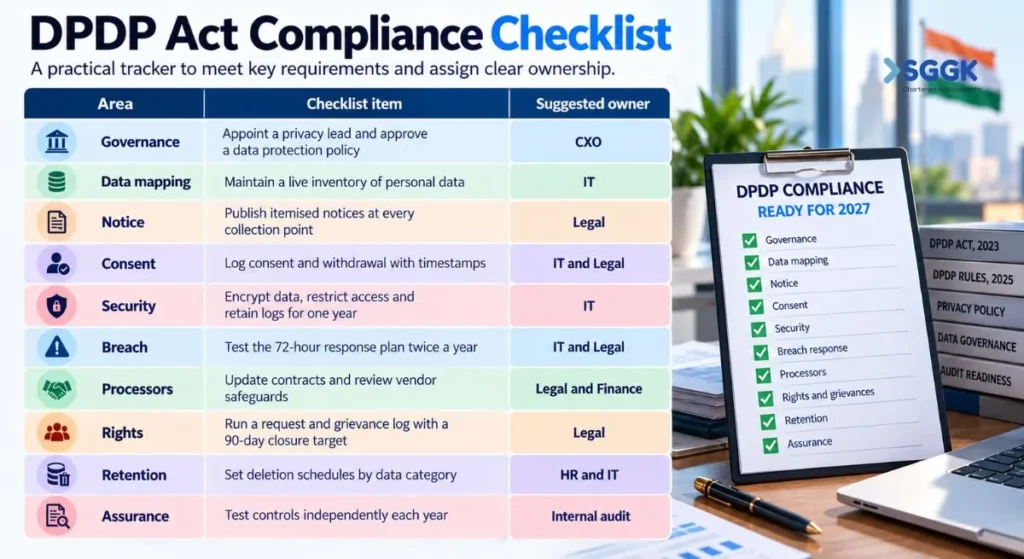
Use this DPDP compliance checklist as a working tracker that maps each of the DPDP Act requirements above to an owner.
Area | Checklist item | Suggested owner |
Governance | Appoint a privacy lead and approve a data protection policy | CXO |
Data mapping | Maintain a live inventory of personal data | IT |
Notice | Publish itemised notices at every collection point | Legal |
Consent | Log consent and withdrawal with timestamps | IT and Legal |
Security | Encrypt data, restrict access and retain logs for one year | IT |
Breach | Test the 72-hour response plan twice a year | IT and Legal |
Processors | Update contracts and review vendor safeguards | Legal and Finance |
Rights | Run a request and grievance log with a 90-day closure target | Legal |
Retention | Set deletion schedules by data category | HR and IT |
Assurance | Test controls each year independently | Internal audit |
How Does Consent Management Work Under the DPDP Act?
Consent management is where law, technology and customer experience meet, and it anchors most DPDP compliance requirements.
What Makes Consent Valid?
- It is free, specific, informed and unambiguous.
- It is given through a clear affirmative action.
- It covers only the stated purpose.
- Withdrawal is as easy as giving it.
Does India Recognise Legitimate Interests?
Unlike GDPR, the Act does not have any concept of legitimate interests in general. Rather, legitimate uses are provided for in Section 7, and thus any procedure based on business interest requires reconsideration.
Employee Data
Section 7 permits certain processing for employment purposes without separate consent. HR teams should still publish a clear notice to staff.
Children’s Data
A child is anyone under 18. Verifiable parental consent applies before processing, and tracking or targeted advertising aimed at children is barred.
What Data Security Measures and Breach Steps Does the Law Expect?
Data security is the control most likely to be tested first, and a breach starts several clocks at once.
Reasonable Security Safeguards
- Encryption, masking or tokenisation of personal data
- Access controls and monitoring of who touches data
- Logs retained for one year to support investigation
Breach Response Timeline
Trigger | Action | Deadline |
You become aware of a breach | Inform affected data principals | Without delay |
Same event | Inform the Data Protection Board | Without delay |
Same event | File a detailed report with the Board | Within 72 hours |
Cyber incident under CERT-In Directions | Report to CERT-In | Within six hours |
Who Owns Privacy Governance in Your Business?
Privacy governance fails when ownership is vague, so assign each function a defined role.
Function | Core responsibility |
Board and CXOs | Set risk appetite, fund the programme, review a quarterly dashboard |
Legal | Notices, contracts, rights requests, Board interface |
IT and security | Data security, logging, access and breach detection |
HR | Employee and candidate data, retention |
Finance | Vendor and payroll data, budgets for controls |
Internal audit | Independent testing and reporting to the audit committee |
What Will an Auditor Ask to See for DPDP Act Compliance?
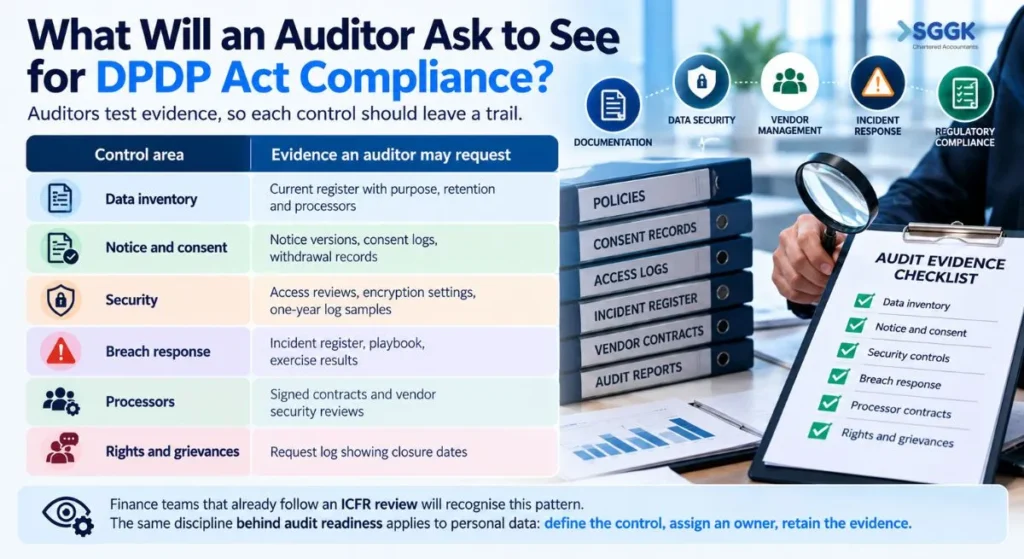
Auditors test evidence, so each control should leave a trail.
Control area | Evidence an auditor may request |
Data inventory | Current register with purpose, retention and processors |
Notice and consent | Notice versions, consent logs, withdrawal records |
Security | Access reviews, encryption settings, one-year log samples |
Breach response | Incident register, playbook, exercise results |
Processors | Signed contracts and vendor security reviews |
Rights and grievances | Request log showing closure dates |
Finance teams that already follow an ICFR review will recognise this pattern. The same discipline behind audit readiness applies to personal data: define the control, assign an owner, retain the evidence.
“Data privacy India programmes often begin with a tool purchase. We suggest beginning with a data map and a named owner for every data flow. A control without an owner cannot be tested, and a control that cannot be tested cannot be relied upon.”
CA Girish V, SGGK
SGGK’s view is that DPDP readiness is an evidence problem before it is a technology problem.
Where Does Personal Data Hide in Finance and HR?
Personal data sits in more places than the CRM, and these are the ones teams tend to overlook:
- Payroll files, bank details and Form 16 copies
- Vendor master records and KYC documents
- Expense claims with receipts and travel details
- Recruitment folders holding candidate résumés
- Visitor registers and CCTV footage
What Should You Do in the Next 30 Days?
Begin with four actions:
- Appoint a privacy lead and form a cross-functional group.
- Complete the first version of your data map.
- Review consent text and processor contracts.
- Schedule a breach tabletop exercise.
Consulting a professional can help you assess how these steps apply to your situation. SGGK offers audit and assurance support from Bangalore for businesses planning their approach to data protection compliance India requires.
Prepare Your Organisation for DPDP Act Compliance
Frequently Asked Questions About DPDP Act Compliance
Does the DPDP Act apply to startups and SMEs?
Yes. The duties attach to any data fiduciary, whatever its size. Some entities may receive notified exemptions.
What is the DPDP Act compliance deadline?
Most obligations apply from 13 May 2027. Consent Manager provisions apply from 13 November 2026.
Who is responsible when a vendor causes a breach?
The data fiduciary remains responsible for processing done by its processor, which is why contracts and vendor reviews matter.
Can a CA firm help with readiness?
A CA firm can support the assurance side, such as control testing, evidence review and reporting. Legal interpretation sits with legal counsel.

Girish V
Fellow Chartered Accountant (FCA), Company Secretary Executive (CS Exe), Bachelor of Commerce (B.Com), and Partner with over 7 years of experience in Audit and Assurance at PwC. Has worked with clients across Information Technology, FMCG, Automobile, Industrial Automation, Renewable Energy, Startups, and Shared Services Centers. Known for strong analytical skills and a practical approach to identifying accounting, compliance, and ethical risks. As a Partner, focuses on management consultancy, audit support, advisory services, and financial reporting, helping clients strengthen governance and compliance frameworks. Areas of Expertise: GAAP (IGAAP & Ind AS), Audit & Assurance, Ind AS Accounting & Transition, Statutory Compliances, Management Consultancy Services, and Internal Control over Financial Reporting (ICFR).